
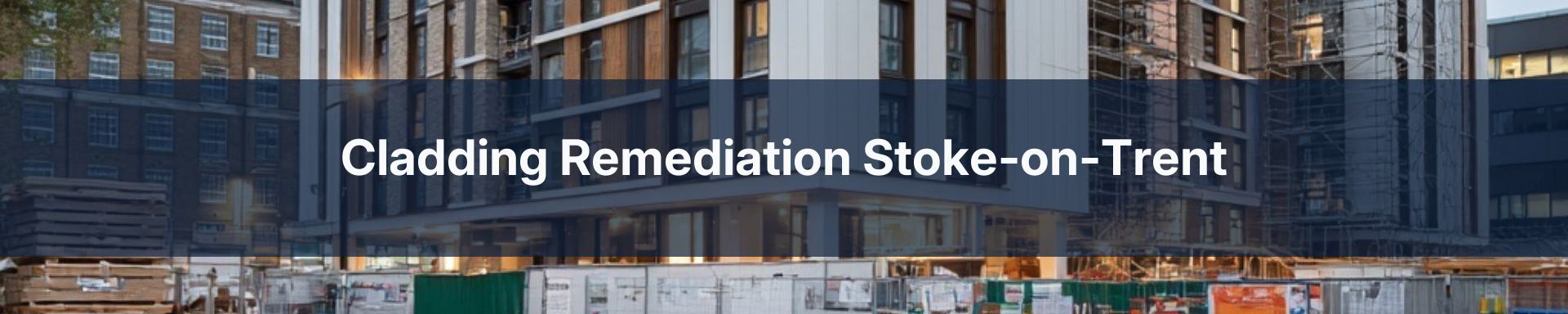
Cladding Remediation in Stoke-on-Trent is the compliance-led correction of an external wall system on Stoke-on-Trent buildings where façade materials, build-ups, or junction conditions create external wall fire-risk, performance failure, or governance uncertainty, and where scope must be set against verified as-built evidence rather than surface assumptions. In Stoke-on-Trent and nearby areas such as Newcastle-under-Lyme, Hanley, Burslem, Tunstall, Fenton, Longton, Stoke, Kidsgrove, Crewe, Congleton, Stafford, and Stone, cladding remediation is commonly driven by mixed residential stock including post-war estates, mid-rise blocks, town-centre apartment schemes, and phased retrofit reclads where façade typologies can vary by elevation and refurbishment phase, records are fragmented across prior landlord works and refurbishment cycles, and risk-significant conditions often sit behind the visible façade within cavities and interface details. Cladding Remediation delivers cladding remediation in Stoke-on-Trent as a system-level external wall correction process that verifies the build-up and then reinstates continuity across the cladding zone, insulation configuration, cavity barrier layout, membranes and sheathing interfaces, subframes and fixings, and interface fire-stopping at openings, slab edges, balconies, parapets, movement joints, and penetrations so remediation decisions and follow-on works are not built on incomplete façade assumptions.
The Stoke-on-Trent-specific outcomes below show how verified evidence is translated into controlled scope, delivery stability, and governance-ready closeout across mixed-typology façades and phased occupied-building delivery.
- Evidence-led cladding remediation scope in Stoke-on-Trent → confirms actual façade defects, mixed-elevation typologies, and interface risk concentration across estates and apartment schemes → remediation targets verified risk drivers rather than panel-only assumptions.
- Access and exposure control planning for Stoke-on-Trent buildings → coordinates scaffold and access logistics and manages time-limited open-cavity windows across live elevations → phased works avoid uncontrolled ingress, security risk, and programme instability.
- Build-up correction and compliant reinstatement in Stoke-on-Trent → restores specification-compliant external wall conditions across façade transitions and refurbishment interfaces → risk is reduced beyond surface-level panel changes.
- Cavity barrier and interface fire-stopping continuity at Stoke-on-Trent junctions → closes concealed void and junction pathways at openings, balconies, slab edges, parapets, movement joints, and penetrations → fire and smoke spread routes are reduced where junction complexity concentrates risk.
- QA evidence capture and closeout documentation for Stoke-on-Trent governance → creates a traceable remediation audit trail aligned to dutyholder, funder, lender and valuer, and project sign-off needs → compliance review, handover, and long-term building assurance are supported.
What Cladding Remediation Services Do We Provide In Stoke-on-Trent?
Cladding Remediation delivers compliance-led cladding remediation by removing risk-significant façade elements and installing corrected, specification-compliant external wall build-ups with continuity across cavities, interfaces, and junction-critical details. Cladding Remediation’s remediation services cover removal, replacement, and full external wall system correction, scoped and sequenced to reduce residual façade risk and support verifiable progression into compliant outcomes.
- External Wall Remediation: system-level façade correction programme (strip-out, correction, continuity reinstatement, closeout-ready evidence).
- Cladding Removal: controlled removal of defective or non-compliant cladding components as part of a managed remediation pathway.
- Unsafe Cladding Removal: targeted controlled strip-out where cladding is unsafe or risk-significant, with exposure control and remediation readiness.
- Cladding Replacement: installation of compliant cladding and associated build-up elements as a continuous external wall system.
- Combustible Cladding Replacement: removal and replacement of combustible cladding with compliant non-combustible or specification-compliant systems.
- ACM Cladding Removal and Replacement: remediation of aluminium composite material cladding systems with compliant replacement build-ups and continuity correction.
- HPL Cladding Removal and Replacement: remediation of high-pressure laminate cladding systems with compliant replacement build-ups and junction continuity reinstatement.
Want a price for a cladding remediation project in Stoke-on-Trent?
When Is Cladding Remediation Required In Stoke-on-Trent?
Cladding remediation in Stoke-on-Trent becomes necessary when investigation shows that the external wall system contains unsafe materials, defective fire protection, or undocumented façade build-ups that cannot demonstrate compliance or safe performance. In Stoke-on-Trent, this most often arises in city-centre and station-corridor regeneration stock, including Smithfield, The Goods Yard, and wider Hanley-linked redevelopment sites, where phased mixed-use delivery, new apartment blocks on former brownfield land, and elevation-by-elevation façade variation can leave concealed risk conditions within cavities, interfaces, and build-up transitions that surface inspection alone cannot reliably resolve.
The Stoke-on-Trent-specific triggers below show when a building moves from façade investigation into a confirmed remediation requirement.
- Installed façade build-up cannot be verified against the approved design, O and M information, or reliable as-built records → the true external wall composition remains uncertain → intrusive findings are used to define a remediation scope rather than relying on incomplete documentation.
- Combustible or otherwise risk-significant cladding, insulation, or membrane layers are identified within the external wall system → the façade contains materials that cannot support a safe and compliant evidence position → remediation is required to remove and replace unsafe build-up elements.
- Cavity barriers are missing, incorrectly located, poorly fitted, displaced, or not continuous at slab edges, openings, balconies, compartment lines, or vertical service zones → concealed fire and smoke spread routes remain within the façade zone → system correction is required to reinstate compliant cavity compartmentation.
- Window perimeters, parapets, balcony interfaces, movement joints, or service penetrations reveal defective fire-stopping or junction continuity → interface conditions weaken compartmentation at the points where failure often concentrates → remediation is required to restore compliant protection at junction-critical locations.
- Persistent rain exposure, wind-driven moisture, or leakage through façade junctions has affected insulation, sheathing, fixings, or interface layers within the wall build-up → deterioration is occurring behind the visible façade and within concealed system layers → remediation is required where failure extends beyond isolated sealant defects or local panel repairs.
- Smithfield phases, The Goods Yard, Etruscan Square, and other regeneration-era schemes contain phased works, overcladding, or façade changes between plots, elevations, and delivery stages → different parts of the building carry inconsistent build-ups and unverified performance conditions → remediation is required where mixed façade zones prevent a reliable whole-building compliance position.
- Fire risk assessments, lender reviews, insurance requirements, or regulatory investigations determine the external wall system cannot remain in place without corrective works → the building no longer holds an acceptable evidence position for occupation, lending, saleability, or regulatory closeout → remediation becomes necessary to achieve a traceable and governable outcome.
In Stoke-on-Trent, remediation becomes unavoidable once verified investigation shows that façade defects, unsafe materials, discontinuous fire protection, or build-up failure cannot be resolved through minor repair or documentation alone, requiring system-level correction of the external wall assembly.
Want a price for a cladding remediation project in Stoke-on-Trent?
Does Your Building in Stoke-on-Trent Need Cladding Remediation?
A building in Stoke-on-Trent needs cladding remediation when verified façade investigation shows that the existing external wall system contains unsafe materials, defective fire protection, moisture-damaged build-up layers, or undocumented assembly conditions that cannot be safely retained or evidentially justified in place. In Stoke-on-Trent, this most often affects regeneration-led and town-centre residential stock around Hanley including Etruscan Square, station-corridor and canalside schemes around Goods Yard in Stoke town, and other brownfield redevelopment plots delivered across the city’s polycentric urban structure, where phased parcel build-out, mixed façade packages, and exposed frontages can leave concealed risk concentrated within cavities, interfaces, and junction-critical details. Where the installed cladding build-up cannot be matched to reliable as-built records, approved design information, or verified opening-up findings, cladding remediation in Stoke-on-Trent becomes necessary because the façade cannot be governed safely on assumption-led scope. Where combustible or otherwise risk-significant cladding materials, insulation layers, membranes, or backing components are identified within the wall build-up, remediation is required to remove unsafe elements and reinstate a compliant external wall configuration. Where cavity barriers, fire-stopping, or compartmentation measures are missing, displaced, poorly fitted, inaccessible, or discontinuous, a building in Stoke-on-Trent requires cladding remediation because concealed fire and smoke pathways remain active behind the visible façade. Where repeated failure is found at window perimeters, slab edges, balconies, parapets, movement joints, or service penetrations, remediation becomes necessary because compliant continuity cannot be restored through isolated local repair alone. Where Stoke-on-Trent’s persistent rain exposure, canal-corridor moisture loading, and weathering across exposed town-centre, station-side, and regeneration-frontage elevations have caused water ingress, corrosion, saturation, or deterioration within the cladding zone, support structure, sheathing, or insulation layers, the building may require system-level façade correction rather than surface-level patching. Cladding Remediation assesses buildings in Stoke-on-Trent against verified façade evidence so the next step is defined by actual build-up condition, interface risk, and compliance need rather than by visible panel appearance or incomplete historical records. If your building in Stoke-on-Trent has unresolved external wall fire-risk findings, suspected combustible cladding, missing cavity barrier evidence, recurring façade leakage, or uncertainty over whether the existing cladding can remain in place, request a cladding remediation assessment to determine the correct remediation pathway.
Want a price for a cladding remediation project in Stoke-on-Trent?