
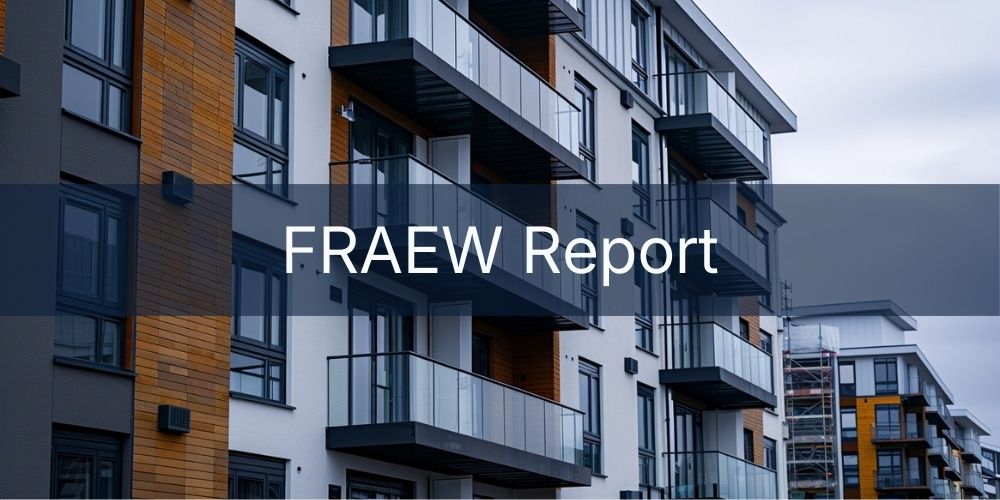
A FRAEW report is a fire risk appraisal of external walls report used to document a structured, evidence-led assessment of a UK building’s external wall system so external wall fire-risk conclusions, risk-reduction priorities, and next-step actions can be determined in line with PAS 9980 and the building’s known construction context. Cladding Remediation delivers FRAEW report support as a compliance-led external wall assessment and remediation-readiness service engineered for the realities of UK building stock, where external wall fire risk is often determined by concealed conditions and interface defects rather than visible cladding panels alone. External wall systems assessed for a FRAEW report are typically layered assemblies that may include cladding components, subframe systems, insulation, cavity barriers, membranes, sheathing, balconies, attachments, and junction detailing around openings and structure. Where external wall conditions are uncertain, undocumented, defective, or potentially risk-significant, a FRAEW report must be informed by a controlled system-level evidence and appraisal process, not a panel-only visual review in isolation. By aligning evidence-led scope definition, external wall build-up investigation, intrusive opening-up support where required, cavity and interface risk assessment, PAS 9980-aligned appraisal inputs, and verifiable documentation for competent professional review, Cladding Remediation delivers FRAEW report support that improves external wall risk interpretation and supports technically coherent progression into risk management, further assessment, or remediation planning on UK buildings.
How Does a FRAEW Report Support External Wall Fire Risk Decisions on UK Buildings?
A FRAEW report supports external wall fire risk decisions on UK buildings by providing a structured, evidence-based appraisal of the external wall system that helps a competent professional determine the significance of external wall fire risk and identify proportionate risk-reduction priorities or next-step actions. Cladding Remediation delivers FRAEW report support for the realities of occupied UK buildings, where legacy façade build-ups, concealed cavity conditions, interface discontinuities, scaffold/access constraints, and incomplete as-built records all affect how external wall evidence must be gathered and interpreted. External wall fire risk is not appraised reliably through visible panel inspection alone when insulation configuration, cavity barrier continuity, or interface fire-stopping conditions at junctions remain unknown, inaccessible, or undocumented. PAS 9980, intrusive opening-up findings where required, interface risk mapping, and quality-assured evidence capture all influence how FRAEW report inputs should be scoped, assembled, and documented. By aligning verified site evidence, assessment boundaries, build-up verification, interface-risk interpretation, and appraisal-ready documentation, Cladding Remediation delivers FRAEW report support that improves decision quality and supports clear progression into risk mitigation, monitoring, or remediation pathways on UK buildings.
- Cladding Remediation defines FRAEW report scope using evidence-led investigation so appraisal boundaries align with verified external wall system conditions and risk concentration zones.
- Cladding Remediation gathers external wall evidence using controlled survey methods and opening-up coordination where required so build-up and material conditions are verified from site evidence rather than panel-only assumptions.
- Cladding Remediation assesses cavities and interfaces for FRAEW report inputs so concealed pathway risk and continuity-critical defects at junctions and transitions are included in external wall fire risk appraisal.
- Cladding Remediation aligns FRAEW report findings with wider risk management and remediation pathways so identified external wall issues can be translated into proportionate next-step actions.
- Cladding Remediation integrates QA evidence capture and verifiable documentation so FRAEW report inputs and outputs are traceable, auditable, and usable for professional review and project governance.
These FRAEW report decisions produce the following performance and assurance outcomes:
- Evidence-led FRAEW report scope definition → confirms relevant façade zones and assessment boundaries → external wall fire risk appraisal is based on appropriate system coverage
- Controlled evidence gathering and build-up verification → confirms actual assembly conditions and material configuration → conclusions are not driven by surface-only or drawing-only assumptions
- Cavity and interface assessment for FRAEW report inputs → identifies concealed pathway risk and continuity-related defects → external wall fire risk interpretation extends beyond visible panel areas
- Alignment with risk management and remediation pathways → connects findings to proportionate next actions → risk-reduction planning and delivery decisions can proceed coherently
- QA evidence capture and verifiable documentation → creates an auditable FRAEW report evidence trail → competent professional review, governance, and follow-on decision-making are better supported
Each of these FRAEW report outcomes is produced by a specific scoping, evidence, interpretation, pathway-alignment, and documentation process, which is set out below.
1. Cladding Remediation Defines FRAEW Report Scope Using Evidence-Led Investigation and Interface Mapping
Cladding Remediation defines FRAEW report scope using evidence-led investigation and interface mapping because external wall fire risk cannot be appraised reliably when assessment boundaries are set only by visible cladding type, isolated elevations, or incomplete records. During mobilisation, Cladding Remediation reviews available building information, façade typologies, known external wall concerns, access constraints, and prior inspection or remediation records to establish appropriate appraisal boundaries for FRAEW report support. Interface mapping is used to identify risk concentration points at openings, slab edges, balconies, parapets, movement joints, support zones, service penetrations, and other transitions that may materially affect external wall fire-risk interpretation. This evidence-led approach ensures FRAEW report activity is directed toward verified system conditions and continuity-critical locations before evidence gathering begins.
2. Cladding Remediation Gathers External Wall Evidence and Verifies Build-Ups Using Controlled Survey Methods
Cladding Remediation gathers external wall evidence and verifies build-ups using controlled survey methods because FRAEW report conclusions depend on what is actually present within the external wall assembly, not what is assumed from drawings or surface inspection alone. Where required and appropriate, Cladding Remediation coordinates intrusive opening-up, sampling support, and condition recording to identify cladding composition, insulation configuration, cavity conditions, and associated façade-system elements within surveyed zones. Survey methods are sequenced to obtain reliable evidence while maintaining control over occupied-building impacts, access logistics, and exposed-condition protection. This controlled evidence-gathering process improves confidence in build-up verification and reduces the risk of panel-only or label-only assumptions being carried into FRAEW report appraisal.
3. Cladding Remediation Assesses Cavities and Interfaces for FRAEW Report Inputs
Cladding Remediation assesses cavities and interfaces for FRAEW report inputs because external wall fire-risk significance is frequently determined at concealed junctions and transitions rather than field panel areas alone. During assessment support activities, conditions at openings, slab edges, balconies, parapets, movement joints, penetrations, subframe interfaces, cavity barrier zones, and interface fire-stopping-relevant locations are reviewed where evidence is available or obtained through survey works. Cladding Remediation interprets these conditions within the wider façade-system logic so FRAEW report inputs reflect continuity performance and concealed pathway risk, not only cladding-face observations. This interface-led assessment approach supports more complete external wall fire risk appraisal and reduces blind spots at detail-critical locations.
4. Cladding Remediation Aligns FRAEW Report Findings With Risk Management and Remediation Pathways
Cladding Remediation aligns FRAEW report findings with risk management and remediation pathways because a FRAEW report often functions as a decision gateway where identified external wall fire-risk issues must be translated into proportionate mitigation, further assessment, monitoring, or remediation actions. PAS 9980 provides the framework for fire risk appraisal of external walls, and appraisal outputs are strongest when findings are structured for clear next-step decision-making rather than left as isolated observations. If FRAEW report findings are not organised for pathway continuity, projects can inherit unclear scope boundaries, repeated opening-up, or misaligned sequencing during subsequent technical or remedial works. Cladding Remediation therefore organises findings so material concerns, cavity barrier issues, interface fire-stopping defects, and façade continuity risks can support coherent risk-reduction and delivery planning.
5. Cladding Remediation Integrates QA Evidence Capture and Verifiable Documentation Into FRAEW Report Support
Cladding Remediation integrates QA evidence capture and verifiable documentation into FRAEW report support because external wall fire risk appraisal decisions depend on clear records of what was assessed, how evidence was obtained, what constraints applied, and what conditions were identified. Survey access constraints, intrusive opening-up records, façade condition evidence, interface observations, and assessment boundaries are documented in a structured format so FRAEW report inputs remain reviewable and auditable by the competent professional and relevant stakeholders. Cladding Remediation records assessment-stage evidence progressively rather than relying on retrospective reconstruction after site activities are complete. This integrated documentation approach produces a clear FRAEW report evidence trail that supports professional review, project governance, and technically coherent progression into further assessment, risk mitigation, or remediation where indicated.
What Does a FRAEW Report in the UK Require for Occupied Buildings and External Wall Systems?
A FRAEW report in the UK requires evidence-led appraisal boundaries, controlled external wall evidence gathering, build-up and material-condition verification, cavity and interface fire-risk appraisal inputs, and assessor-ready documentation with verifiable closeout records so external wall fire-risk conclusions are supported by defensible evidence rather than visible-panel assumptions alone. Cladding Remediation delivers FRAEW report support for the realities of UK building stock, where appraisal outcomes are often affected by concealed cavity conditions, interface discontinuities, access constraints, and incomplete records across mixed façade assemblies. On occupied buildings, FRAEW evidence activity must be planned around live operations, phased access, scaffold logistics, and exposed-condition controls where intrusive inspection or opening-up is required. PAS 9980-aligned appraisal expectations shape how FRAEW scope, evidence capture, system-level interpretation, and reporting records should be structured so findings can support proportionate risk-reduction planning and coherent next-step decisions. By aligning verified site evidence, assessment-stage controls, interface-risk interpretation, and closeout governance, Cladding Remediation delivers FRAEW report support that improves appraisal quality, reduces uncertainty, and supports technically coherent progression into risk mitigation, monitoring, or remediation pathways on UK buildings.
The UK-specific requirements that govern FRAEW report performance include:
- Evidence-Led FRAEW Report Boundary Definition for UK Buildings
- Controlled External Wall Evidence Gathering and Access Planning for FRAEW
- Build-Up and Material-Condition Verification Requirements for FRAEW Appraisal
- Cavity and Interface Fire-Risk Appraisal Requirements for FRAEW Inputs
- Assessor-Ready Documentation and FRAEW Report Closeout Record Requirements
The causal requirements listed above determine how each FRAEW report programme should be planned and delivered on occupied UK buildings, as set out below.
- Evidence-led FRAEW boundary definition → confirms relevant external wall appraisal zones and assessment limits → conclusions are based on appropriate system coverage rather than assumed cladding extent
- Controlled evidence gathering and access planning → enables reliable appraisal inputs on occupied buildings → evidence quality improves without unmanaged disruption or unsafe sequencing
- Build-up and material-condition verification → confirms what is actually present within the external wall assembly → appraisal is not driven by drawing-only, label-only, or panel-only assumptions
- Cavity and interface fire-risk appraisal inputs → capture continuity-critical junction conditions and concealed pathway significance → external wall fire-risk interpretation extends beyond field panel areas
- Assessor-ready documentation and closeout records → create a verifiable FRAEW evidence trail → professional review, governance, and next-step risk-reduction decisions are better supported
1. Evidence-Led FRAEW Report Boundary Definition for UK Buildings
A FRAEW report in the UK must begin with evidence-led boundary definition because external wall fire risk cannot be appraised reliably when appraisal scope is set only by visible cladding type, isolated elevations, or incomplete building records. Cladding Remediation reviews available façade information, known external wall concerns, building configuration, access constraints, and prior inspection or remediation records to define appropriate appraisal boundaries before evidence gathering proceeds. This boundary-definition process considers façade typologies, transitions, balconies, parapets, openings, service penetrations, and other likely risk-concentration zones that may materially affect external wall fire-risk interpretation under PAS 9980. This evidence-led requirement helps ensure FRAEW activity is directed toward relevant system conditions and not narrowed prematurely to surface-level assumptions.
2. Controlled External Wall Evidence Gathering and Access Planning for FRAEW
A FRAEW report in the UK requires controlled external wall evidence gathering and access planning because reliable appraisal inputs often depend on coordinated access to façade zones, junctions, and concealed build-up locations on occupied buildings. Cladding Remediation plans access routes, work-zone controls, phased activity sequencing, and opening-up coordination where required so evidence can be obtained in controlled stages while protecting residents, occupants, and ongoing building operations. Where intrusive inspection is needed, evidence activity is coordinated to reduce avoidable disruption and maintain control over exposed conditions and temporary protections. This controlled evidence-gathering requirement improves FRAEW practicality and supports more dependable appraisal inputs on occupied UK buildings.
3. Build-Up and Material-Condition Verification Requirements for FRAEW Appraisal
A FRAEW report in the UK requires build-up and material-condition verification because PAS 9980-aligned appraisal conclusions depend on what is actually present within the external wall assembly, not what is assumed from visual inspection, legacy drawings, or façade labels alone. Cladding Remediation supports verification through façade build-up review, condition recording, and opening-up/sampling coordination where required so cladding composition, insulation configuration, cavity conditions, and associated assembly elements can be evidenced within appraisal zones. Material-condition verification is structured to support system-level interpretation rather than isolated component identification in field panel areas only. This requirement reduces incomplete evidence risk and improves the reliability of FRAEW appraisal inputs.
4. Cavity and Interface Fire-Risk Appraisal Requirements for FRAEW Inputs
A FRAEW report in the UK requires cavity and interface fire-risk appraisal inputs because external wall fire-risk significance is frequently determined at concealed junctions, transitions, and continuity-critical detail zones rather than visible panel areas alone. During FRAEW support activity, Cladding Remediation assesses and records conditions at openings, slab edges, balconies, parapets, movement joints, service penetrations, subframe interfaces, cavity barrier locations, and interface fire-stopping-relevant zones where evidence is available or obtained. These conditions are interpreted within the wider external wall system context so FRAEW inputs reflect concealed pathway risk and continuity-related defects, not only face-material observations. This interface-led requirement supports more defensible external wall fire-risk appraisal and reduces decision blind spots at detail-critical locations.
5. Assessor-Ready Documentation and FRAEW Report Closeout Record Requirements
A FRAEW report in the UK requires assessor-ready documentation and verifiable closeout records because external wall fire-risk conclusions and risk-reduction priorities depend on clear evidence of what was assessed, how evidence was obtained, what constraints applied, and what conditions were identified. Cladding Remediation coordinates evidence logs, façade condition records, interface mapping outputs, access records, intrusive opening-up findings where applicable, and supporting photographs/documentation into a structured evidence trail suitable for competent professional review and project governance. Documentation is compiled progressively during appraisal activity rather than reconstructed retrospectively after site works are complete. This closeout-record requirement improves FRAEW evidence usability, supports auditability, and enables clearer progression into risk mitigation, monitoring, or remediation planning where indicated.
Have a question about an upcoming project?
How Do FRAEW Report Findings Affect Risk Mitigation, Remediation Planning, and Next-Step Decisions on UK Buildings?
FRAEW report findings affect risk mitigation, remediation planning, and next-step decisions on UK buildings by translating verified external wall system evidence into proportionate conclusions on external wall fire-risk significance and by identifying whether risk should be managed through monitoring and controls, mitigated through targeted correction, or progressed into wider remediation planning. On occupied UK buildings, FRAEW findings are often shaped by build-up verification results, concealed cavity conditions, interface discontinuities, access constraints, and evidence limitations, which means next-step decisions must be made against what has been verified and what remains uncertain rather than against visible cladding appearance alone. Where appraisal evidence indicates combustible materials, continuity-critical defects, missing cavity barriers, compromised interface fire stopping, or unclear as-built configuration, decisions must be structured so findings are converted into coherent actions instead of remaining as descriptive observations without delivery consequence. PAS 9980-aligned appraisal expectations, project governance requirements, and proportionate risk-reduction principles influence how FRAEW findings should be documented, reviewed, and used to support next-step action planning. By aligning verified evidence, finding classification, pathway-ready documentation, and decision continuity into mitigation and remediation workflows, Cladding Remediation delivers FRAEW report support that improves decision clarity and supports defensible progression into risk management, further assessment, or remediation planning on UK buildings.
- Cladding Remediation structures FRAEW report findings so risk significance and evidence limitations are clear for competent professional review and governance decision-making.
- Cladding Remediation uses FRAEW findings to define proportionate risk mitigation actions so identified issues translate into practical controls, monitoring, or interim measures where appropriate.
- Cladding Remediation uses FRAEW findings to support remediation planning decisions so evidence of risk-significant materials or continuity defects can be translated into coherent corrective scope and sequencing logic.
- Cladding Remediation uses FRAEW findings to identify where further evidence or targeted opening-up is required so unresolved uncertainty does not persist into governance decisions or remediation design assumptions.
- Cladding Remediation integrates documentation, traceability, and closeout records so FRAEW findings can be handed off into project teams, building owners, and remediation pathways with clear evidence continuity.
These FRAEW report finding pathways produce the following decision and delivery outcomes:
- Risk significance clarification → defines what has been evidenced and what remains uncertain → governance decisions are made against defensible appraisal information
- Proportionate mitigation planning → translates findings into practical risk-management actions → interim risk controls and monitoring can be implemented coherently where required
- Remediation decision support → connects risk-significant findings to corrective scope logic → remediation planning proceeds with stronger evidence alignment and fewer assumption gaps
- Further evidence escalation where required → identifies where opening-up or verification is needed to close critical uncertainty → next-step decisions are not undermined by unresolved build-up questions
- Documentation and handover continuity → creates a traceable FRAEW evidence trail for stakeholder use → mitigation, remediation, and governance pathways progress on a consistent record
Each of these FRAEW report finding outcomes is produced by a specific finding-clarification, mitigation-planning, remediation-planning, evidence-escalation, and documentation-handover process, which is set out below.
1. FRAEW Report Findings Clarify Risk Significance and Evidence Limitations for Governance Review
FRAEW report findings clarify risk significance and evidence limitations for governance review because external wall fire-risk decisions must be made against what has been verified, what has been assessed, and what constraints affected evidence capture. Cladding Remediation supports this stage by structuring findings so verified build-up conditions, assessed zones, observed defects, and evidence limitations are explicit and reviewable by the competent professional and relevant stakeholders. This includes clear linkage between evidence obtained, the appraisal boundary, and the confidence associated with key conclusions. This governance-ready framing reduces misinterpretation and supports more defensible next-step decision-making based on documented external wall conditions.
2. FRAEW Report Findings Inform Proportionate Risk Mitigation Actions and Interim Controls
FRAEW report findings inform proportionate risk mitigation actions and interim controls because not every identified issue requires immediate full remediation, but risk-reduction steps must still be coherent when risk-significant conditions are identified or suspected. Cladding Remediation supports mitigation planning by translating findings into practical action logic such as monitoring requirements, maintenance and access controls, interim risk-management measures, or targeted corrective actions where appropriate to the building’s context and evidence position. Where findings indicate specific interface vulnerabilities or continuity risks, mitigation actions are framed to address the relevant pathways rather than relying on generic statements. This mitigation-planning process helps ensure FRAEW outputs drive usable risk-management decisions rather than remaining report-only observations.
3. FRAEW Report Findings Support Remediation Planning and Corrective Scope Decisions
FRAEW report findings support remediation planning and corrective scope decisions because evidence of combustible materials, cavity barrier discontinuity, interface fire-stopping defects, or other continuity-critical issues must be translated into technically coherent correction logic when remediation is required. Cladding Remediation structures findings so risk-significant conditions can inform remediation boundaries, interface ownership, and sequencing dependencies instead of being left as unscoped concerns. Where defects are evidenced at junctions, transitions, or concealed cavities, findings are organised to support system-level correction planning rather than panel-only replacement assumptions. This remediation-planning support improves decision continuity from appraisal into design and delivery where corrective works are indicated.
4. FRAEW Report Findings Identify Where Further Evidence or Targeted Opening-Up Is Required
FRAEW report findings identify where further evidence or targeted opening-up is required because unresolved uncertainty can undermine proportionate decision-making when key build-up conditions, cavity barrier layout, or interface fire-stopping continuity cannot be verified within the appraisal evidence set. Cladding Remediation supports this escalation stage by highlighting critical evidence gaps and defining what additional verification would be required to close uncertainty that materially affects risk interpretation or remediation scope decisions. This prevents appraisal outputs from being treated as final where evidence limitations remain decisive, and it supports structured progression into further assessment activity where required. This evidence-escalation process reduces the risk of remediation planning being built on unverified assumptions and reduces repeat opening-up later in delivery stages.
5. FRAEW Report Findings Support Documentation Continuity, Handover, and Next-Step Pathway Progression
FRAEW report findings support documentation continuity, handover, and next-step pathway progression because appraisal decisions must be usable by owners, project teams, and stakeholders who may need to implement mitigation actions, commission design work, or progress remediation planning. Cladding Remediation coordinates findings, evidence logs, interface mapping outputs, opening-up records where applicable, and closeout documentation into a structured evidence trail suitable for handover and governance continuity. This documentation set is compiled progressively so that appraisal rationale and evidence traceability remain clear beyond the report issuance stage. This handover-focused process improves auditability, supports consistent stakeholder interpretation, and enables clearer progression into risk mitigation, monitoring, or remediation planning where indicated.
When Is a FRAEW Report Needed on a UK Building, and Does Every Building Require One?
A FRAEW report is needed on a UK building when a proportionate external wall fire-risk appraisal is required to support risk management, governance decision-making, remediation planning, or next-step action selection under a PAS 9980-aligned evidence and appraisal pathway. Not every building automatically requires a FRAEW report, because commissioning decisions should be based on building-specific external wall characteristics, known or suspected risk indicators, available records, evidence uncertainty, and the decision context the appraisal must support rather than assumptions based on visible cladding presence alone. On many UK buildings, the need for a FRAEW report is governed by the wider external wall system behind and around the façade zone, including insulation configuration, cavity barrier continuity, interface fire-stopping conditions, subframe interfaces, membranes, sheathing, attachments, balconies, and junction detailing at openings, slab edges, parapets, movement joints, and service penetrations. Where these conditions remain uncertain, undocumented, or potentially risk-significant, a FRAEW report provides the structured appraisal basis needed to determine whether risk can be managed through proportionate mitigation and monitoring or whether evidence supports progression into remediation planning. On occupied buildings, delaying FRAEW appraisal until late-stage decisions are required can increase programme uncertainty through reactive opening-up, repeated access planning, scaffold dependency, and fragmented evidence capture under time pressure. By aligning evidence-led scope definition, build-up verification, interface-risk interpretation, PAS 9980-aligned appraisal inputs, and governance-ready documentation, Cladding Remediation delivers FRAEW report support that helps building teams determine whether a FRAEW report is required, what it must cover, and how its findings should be progressed into proportionate next-step action planning.
These FRAEW report applicability decisions produce the following trigger and progression outcomes:
- Cladding Remediation identifies when a FRAEW report is required by assessing external wall uncertainty, known risk indicators, and decision needs against a PAS 9980-aligned appraisal pathway.
- Cladding Remediation confirms that not every building requires a FRAEW report by applying building-specific evidence thresholds so commissioning decisions are proportionate and defensible.
- Cladding Remediation evaluates external wall system features and interface risk concentration so the need for FRAEW appraisal is determined by system-level conditions, not visible panel appearance alone.
- Cladding Remediation uses early evidence screening and opening-up planning where required so appraisal activity can be scoped before governance, mitigation, or remediation decisions stall.
- Cladding Remediation structures documentation and appraisal-readiness records so FRAEW report commissioning and progression decisions are reviewable, auditable, and usable across stakeholders.
Each of these FRAEW report applicability outcomes is produced by a specific trigger-identification, applicability, system-screening, evidence-planning, and documentation process, which is set out below.
- Decision-context trigger identification → confirms when a FRAEW report is needed to support governance, mitigation, or remediation decisions → appraisal activity is commissioned for a defined purpose rather than as a default exercise
- Proportionate building-specific applicability review → avoids blanket assumptions that every building requires FRAEW appraisal → scope and commissioning decisions align with verified evidence thresholds
- System-feature and interface-risk screening → identifies where concealed conditions or continuity defects may materially affect fire-risk interpretation → appraisal readiness is improved before decisions are time-critical
- Early evidence and opening-up planning where required → closes decisive uncertainty before late-stage governance decisions → repeated access, reactive opening-up, and fragmented evidence capture are reduced
- Documentation and progression continuity → creates a traceable rationale for why FRAEW appraisal was commissioned and how it is progressed → next-step planning is better supported across stakeholders
1. A FRAEW Report Is Needed When a PAS 9980-Aligned Appraisal Is Required to Support Decisions
A FRAEW report is needed when a PAS 9980-aligned appraisal is required to support external wall fire-risk decisions, including risk mitigation selection, monitoring strategy decisions, governance reviews, and remediation planning. Cladding Remediation supports this trigger stage by clarifying the decision context the FRAEW report must serve, defining what the appraisal must resolve, and aligning scope boundaries to the external wall system conditions most likely to influence risk interpretation. This trigger-led approach ensures FRAEW commissioning is driven by a defined decision requirement rather than by generic assumptions about cladding presence or building type. It also improves appraisal efficiency by aligning evidence capture to the decisions that must be made from the findings.
2. Not Every UK Building Requires a FRAEW Report, and Applicability Must Be Evidence-Led
Not every UK building requires a FRAEW report because appraisal commissioning should be proportionate to building-specific evidence uncertainty and the risk-significance of external wall system features rather than applied as a default requirement. Cladding Remediation supports evidence-led applicability by reviewing available façade records, known construction features, prior inspection outputs, and observed risk indicators to determine whether FRAEW appraisal is necessary for the decision context in scope. Where records are clear and risk indicators are low within the relevant decision pathway, a full FRAEW report may not be the proportionate next step; where uncertainty is decisive, FRAEW appraisal may be required to prevent governance decisions being made on unverified assumptions. This applicability logic improves proportionality and supports defensible commissioning decisions.
3. External Wall System Features and Interface Risk Concentration Often Determine FRAEW Need
External wall system features and interface risk concentration often determine whether a FRAEW report is needed because external wall fire-risk significance is frequently governed by concealed conditions at cavities, junctions, and transitions rather than by the visible cladding surface alone. Cladding Remediation evaluates system features such as insulation configuration, cavity barrier layout, interface fire stopping, attachment zones, subframe conditions, balcony interfaces, and junction detailing at openings, slab edges, parapets, penetrations, and movement joints to determine whether the external wall system contains conditions that justify structured appraisal. Where risk-significant features or unresolved continuity questions are present, FRAEW appraisal provides the mechanism to interpret evidence proportionately under PAS 9980. This system-led screening reduces panel-only commissioning decisions and improves appraisal relevance.
4. Evidence Gaps and Opening-Up Requirements Can Trigger FRAEW Commissioning and Define Scope
Evidence gaps and opening-up requirements can trigger FRAEW commissioning because external wall fire-risk appraisal cannot be reliable when decisive assembly conditions remain unknown, inaccessible, or undocumented. Where insulation type, cavity barrier continuity, interface fire-stopping condition, or build-up configuration cannot be confirmed through available records and non-intrusive evidence, targeted opening-up and verification may be required to support FRAEW appraisal. Cladding Remediation supports this stage by identifying what information is missing, where verification would be most risk-relevant, and how evidence capture can be sequenced on occupied buildings with controlled disruption and exposed-condition protection. This evidence-led planning reduces late-stage rework and helps ensure FRAEW outputs are based on verified assembly conditions rather than unresolved uncertainty.
5. Documentation and Progression Planning Ensure FRAEW Outputs Can Be Used for Next-Step Actions
Documentation and progression planning ensure FRAEW outputs can be used for next-step actions because appraisal findings must be transferable into mitigation planning, monitoring decisions, governance review, or remediation pathways without loss of evidence continuity. Cladding Remediation structures commissioning rationale, appraisal scope boundaries, evidence logs, interface mapping outputs, opening-up records where applicable, and closeout documentation so the FRAEW report and its supporting evidence set remain traceable and reviewable across stakeholders. This documentation-led approach ensures that if findings indicate mitigation actions, further assessment, or remediation planning, the next stage can proceed without repeating evidence capture due to incomplete records. This progression continuity improves auditability and supports proportionate decision-making beyond the report issuance stage
When Does a UK Building Need Professional FRAEW Report Support?
If a UK building has unresolved external wall fire-risk uncertainty, known or suspected combustible materials within the external wall system, incomplete records of insulation configuration or cavity barrier layout, or uncertainty around interface fire-stopping continuity at junction-critical locations, professional FRAEW report support should be assessed before governance decisions, risk-mitigation planning, or remediation pathways are progressed on assumptions rather than verified evidence. A FRAEW report should be commissioned and scoped against the external wall system as a whole, because external wall fire-risk significance is frequently determined by concealed conditions across cavities, interfaces, and continuity-critical junctions rather than visible cladding panels alone. On many UK buildings, the need for FRAEW appraisal is governed by the wider external wall assembly behind and around the façade zone, including insulation configuration, cavity barrier continuity, interface fire-stopping conditions, subframe interfaces, membranes, sheathing layers, attachments, balconies, and junction detailing at openings, slab edges, parapets, movement joints, and service penetrations. Where these conditions remain uncertain, undocumented, inaccessible, or inconsistently evidenced, risk-reduction decisions can stall or be misdirected, and later remediation planning can inherit avoidable scope ambiguity and repeat opening-up. PAS 9980-aligned appraisal expectations shape how FRAEW report scope, evidence capture, system-level interpretation, and reporting records should be structured so conclusions and risk-reduction priorities are proportionate and defensible. On occupied buildings, delayed FRAEW appraisal can increase programme complexity through reactive access planning, scaffold dependency, phased disruption, and fragmented evidence capture under time pressure once governance decisions become urgent. Cladding Remediation supports professional FRAEW report commissioning and delivery through evidence-led review of façade typologies, build-up conditions, interface risk concentration, continuity-critical junctions, access constraints, and documentation/closeout requirements so appraisal boundaries, evidence pathways, and reporting inputs are defined against verified system conditions and the decision context the report must serve. This allows FRAEW report activity to be progressed on a technically coherent, reviewable basis rather than through panel-only assumptions, incomplete records, or late-stage pressure to reach conclusions without sufficient evidence. Where required, Cladding Remediation can support the next technically correct step, whether that is appraisal scope definition, targeted intrusive opening-up and build-up verification, interface mapping and continuity assessment, PAS 9980-aligned evidence packaging for competent professional review, or structured closeout documentation to support mitigation planning and subsequent remediation decisions. If your building has external wall fire-risk uncertainty, incomplete façade records, evidence gaps that affect risk interpretation, or a need to progress proportionate risk mitigation or remediation planning under PAS 9980, request a FRAEW report support assessment or appraisal scope review to determine the appropriate next step for the building.