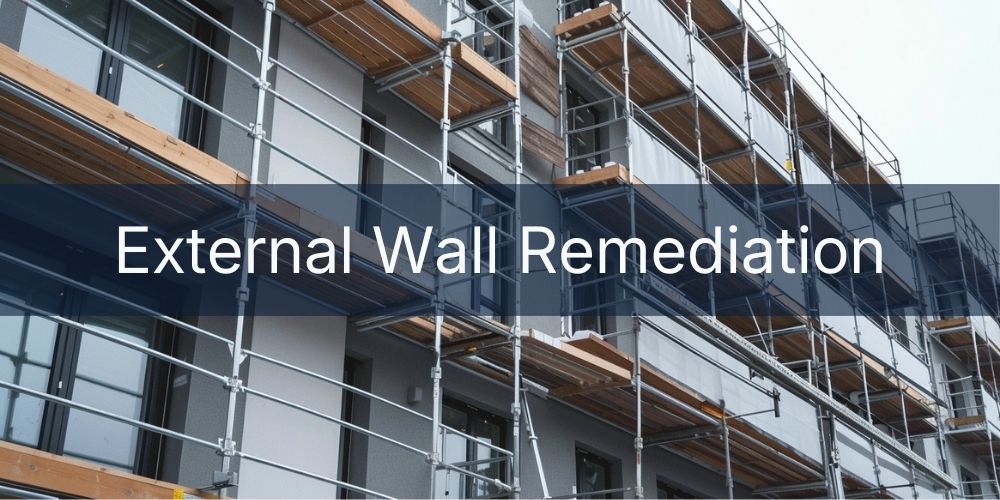
An external wall remediation programme is a compliance-led external wall system correction process used to remove, repair, replace, or upgrade defective, non-compliant, or risk-significant façade components and associated assembly conditions on a UK building so the external wall system can perform in line with the agreed fire strategy, remediation design intent, and project governance requirements. Cladding Remediation delivers external wall remediation as a system-correction service engineered for the realities of UK building stock, where residual façade risk and compliance outcomes are often determined by concealed conditions across cavities, interfaces, and continuity-critical junctions rather than visible cladding panels alone. External wall remediation typically relates to a layered external wall assembly that may include cladding components, subframe systems, insulation, cavity barriers, membranes, sheathing, fire stopping at interfaces, and junction detailing around openings and structure. Where external wall conditions are uncertain, defective, non-compliant, or discontinuous, remediation must be delivered as a controlled system-correction process, not a panel-only replacement exercise in isolation. By aligning evidence-led scope definition, controlled strip-out and enabling works, compliant build-up correction, cavity and interface continuity reinstatement, and verifiable QA/closeout documentation, Cladding Remediation delivers external wall remediation that reduces residual façade risk and supports long-term building assurance on UK buildings.
How Does External Wall Remediation Correct External Wall Risk on UK Buildings?
External wall remediation corrects external wall risk on UK buildings by removing or correcting risk-significant façade conditions and reinstating a compliant, continuous external wall assembly across panels, cavities, interfaces, and junction-critical locations. On occupied UK buildings, remediation performance is shaped by legacy build-ups, concealed cavity defects, interface discontinuities, access/scaffold constraints, phased delivery requirements, and incomplete as-built records, which means panel replacement alone is often insufficient to achieve a technically coherent correction. Risk can remain after visible works if insulation configuration, cavity barrier continuity, interface fire stopping, subframe conditions, or junction detailing defects are not identified and corrected as part of the wider assembly. PAS 9980/FRAEW-aligned evidence pathways, intrusive opening-up findings, remediation design requirements, temporary protection controls, and QA evidence capture influence how remediation scope, sequencing, and verification should be structured. By aligning verified site evidence, remediation boundaries, correction sequencing, continuity reinstatement, and closeout governance, Cladding Remediation delivers external wall remediation that improves delivery quality and supports verifiable compliance and assurance outcomes on UK buildings.
- Cladding Remediation defines external wall remediation scope using evidence-led building and façade review so correction boundaries align with verified defects, assembly conditions, and risk concentration zones.
- Cladding Remediation undertakes controlled strip-out, enabling works, and access sequencing so occupied-building operations and exposed façade conditions remain protected during phased remediation.
- Cladding Remediation corrects external wall build-ups and material configurations so remediated assemblies align with the agreed fire strategy and remediation design intent.
- Cladding Remediation reinstates cavity barrier and interface fire-stopping continuity so concealed spread pathways and junction-condition defects are not left behind after visible façade works.
- Cladding Remediation integrates QA evidence capture, traceability, and closeout documentation so external wall remediation outputs are verifiable, auditable, and governable through completion and handover.
These external wall remediation decisions produce the following performance and assurance outcomes:
- Evidence-led external wall remediation scope definition → confirms actual defect locations, affected façade zones, and correction boundaries → remediation targets verified risk drivers rather than assumed panel extents
- Controlled strip-out, enabling works, and access sequencing → maintains exposure control and delivery stability on occupied buildings → phased remediation proceeds without unmanaged disruption or avoidable condition loss
- Build-up and material-configuration correction → restores compliant external wall assembly conditions → residual façade risk is reduced beyond visible panel replacement alone
- Cavity barrier and interface continuity reinstatement → closes concealed void and junction spread pathways → remediated façades perform as a continuous system through transitions and detail zones
- QA evidence capture, traceability, and closeout documentation → creates a verifiable remediation audit trail → compliance review, sign-off, and long-term building governance are better supported
Each of these external wall remediation outcomes is produced by a specific scoping, enabling, correction, continuity-reinstatement, and assurance process, which is set out below.
1. Cladding Remediation Defines External Wall Remediation Scope Using Evidence-Led Building and Façade Review
Cladding Remediation defines external wall remediation scope using evidence-led building and façade review because external wall systems cannot be corrected reliably when remediation boundaries are set only by visible cladding type, isolated elevations, or incomplete records. During mobilisation, Cladding Remediation reviews available building information, façade typologies, known external wall defects, access constraints, prior inspection findings, and remediation records to establish appropriate correction boundaries and sequencing dependencies. This scoping review considers elevation complexity, façade transitions, balconies, parapets, openings, service penetrations, and other likely risk-concentration zones that may materially affect remediation design and delivery outcomes. This evidence-led approach ensures remediation activity is directed toward verified system defects and affected assembly conditions before strip-out and correction works begin.
2. Cladding Remediation Undertakes Controlled Strip-Out, Enabling Works, and Access Sequencing
Cladding Remediation undertakes controlled strip-out, enabling works, and access sequencing because external wall remediation on occupied UK buildings often requires phased removal and correction activities while maintaining control over exposed conditions, temporary protections, and resident/occupant safety. Where remediation requires opening-up, component removal, or temporary weathering measures, works are sequenced by elevation, zone, and interface dependency so correction can proceed in controlled stages. Cladding Remediation coordinates access routes, scaffold interfaces, work-zone controls, temporary protection measures, and enabling activities to reduce avoidable disruption and maintain stable delivery conditions. This controlled enabling and strip-out process improves remediation practicality and reduces the risk of unmanaged exposure, sequencing conflicts, or repeat access caused by poorly phased works.
3. Cladding Remediation Corrects External Wall Build-Ups and Material Configurations
Cladding Remediation corrects external wall build-ups and material configurations because external wall remediation must restore a compliant and coherent assembly, not only replace visible façade components. Following strip-out or opening-up, remediation may require coordinated correction across outer finishes, insulation arrangement, subframe interfaces, membranes and sheathing, cavity zones, and junction detailing at openings, slab edges, balconies, parapets, and compartment-related interfaces. Cladding Remediation delivers build-up correction using compatible sequencing, tolerance control, and interface coordination so remediated assembly conditions align with the agreed fire strategy and remediation design intent. This build-up correction process reduces residual risk arising from partial replacement logic and supports a technically coherent external wall system outcome.
4. Cladding Remediation Reinstates Cavity Barrier and Interface Fire-Stopping Continuity During External Wall Remediation
Cladding Remediation reinstates cavity barrier and interface fire-stopping continuity during external wall remediation because residual external wall risk often remains at concealed cavities and junction interfaces even after visible façade defects have been addressed. Cavity barriers may be missing, discontinuous, misaligned, incorrectly oriented, or bypassed at openings and transitions, while interface fire stopping may be incomplete or broken across complex junction geometry. Cladding Remediation corrects these continuity-critical conditions across cavity barrier zones, penetrations, corners, slab edges, balconies, parapets, movement joints, and other interface locations, and records continuity-related evidence as works progress. This continuity-reinstatement process prevents external wall remediation from becoming a surface-only exercise and supports a remediated façade assembly that performs as a continuous system.
5. Cladding Remediation Integrates QA Evidence Capture, Traceability, and Verifiable Closeout Documentation
Cladding Remediation integrates QA evidence capture, traceability, and verifiable closeout documentation because compliant external wall remediation on UK buildings must be reviewable, auditable, and support long-term building governance after works completion. Phased access conditions, enabling works, temporary protections, strip-out extents, build-up corrections, cavity barrier installation, interface fire-stopping correction, and material traceability are documented in a structured format throughout delivery rather than reconstructed retrospectively at closeout. Cladding Remediation records progressive evidence and inspection outputs so remediation-stage decisions, corrected conditions, and as-built outcomes remain clear for review and handover. This integrated assurance approach produces a verifiable remediation audit trail that supports compliance review, project governance, sign-off, and subsequent maintenance planning.
What Does External Wall Remediation in the UK Require for Occupied Buildings and External Wall Systems?
External wall remediation in the UK requires evidence-led remediation boundaries, controlled access and enabling works, compliant build-up and material correction, cavity and interface continuity reinstatement, and verifiable QA/closeout records so external wall system correction is delivered against confirmed assembly conditions rather than visible-panel assumptions alone. Cladding Remediation delivers external wall remediation for the realities of UK building stock, where remediation outcomes are often affected by concealed cavity conditions, interface discontinuities, phased access constraints, and incomplete records across mixed façade assemblies. On occupied buildings, external wall remediation must be planned around live operations, scaffold logistics, temporary protection measures, weather exposure controls, and staged work-zone sequencing while corrective works are undertaken. PAS 9980/FRAEW-aligned evidence pathways, remediation design requirements, agreed fire strategy outputs, and project governance/sign-off pathways influence how remediation scope, sequencing, correction evidence, and closeout records should be structured and delivered on UK buildings. By aligning verified site evidence, remediation-stage controls, continuity-critical correction, and closeout governance, Cladding Remediation delivers external wall remediation that improves delivery quality, reduces residual façade risk, and supports technically coherent compliance outcomes on occupied UK buildings.
The UK-specific requirements that govern external wall remediation performance include:
- Evidence-Led External Wall Remediation Boundary Definition for UK Buildings
- Controlled Access, Enabling Works, and Temporary Protection Planning
- Build-Up and Material-Configuration Correction Requirements for External Wall Remediation
- Cavity Barrier and Interface Fire-Stopping Continuity Reinstatement Requirements
- QA, Traceability, and External Wall Remediation Closeout Record Requirements
The causal requirements listed above determine how each external wall remediation programme should be planned and delivered on occupied UK buildings, as set out below.
- Evidence-led remediation boundary definition → confirms affected façade zones, defect locations, and correction interfaces → remediation scope targets verified system defects rather than assumed panel extents
- Controlled access, enabling works, and temporary protection planning → enables phased corrective works on occupied buildings → remediation proceeds with managed exposure, safer sequencing, and reduced disruption
- Build-up and material-configuration correction → restores compliant assembly conditions in line with remediation design intent → residual façade risk is reduced beyond visible component replacement alone
- Cavity barrier and interface continuity reinstatement → closes concealed spread pathways and continuity-critical junction defects → remediated external wall systems perform as continuous assemblies through transitions
- QA, traceability, and closeout records → create a verifiable remediation audit trail → compliance review, sign-off, and long-term building governance are better supported
1. Evidence-Led External Wall Remediation Boundary Definition for UK Buildings
External wall remediation in the UK must begin with evidence-led remediation boundary definition because external wall systems cannot be corrected reliably when remediation scope is set only by visible cladding type, isolated elevations, or incomplete building records. Cladding Remediation reviews available façade information, known defects, prior inspection findings, building configuration, access constraints, and remediation design inputs to define appropriate correction boundaries before strip-out and enabling works proceed. This boundary-definition process considers façade typologies, transitions, balconies, parapets, openings, service penetrations, and other likely risk-concentration zones that may materially affect remediation design and delivery outcomes. This evidence-led requirement helps ensure external wall remediation is directed toward verified system defects and affected assembly conditions rather than narrowed prematurely to surface-level assumptions.
2. Controlled Access, Enabling Works, and Temporary Protection Planning
External wall remediation in the UK requires controlled access, enabling works, and temporary protection planning because occupied buildings must remain protected while phased corrective works are delivered across live elevations. Cladding Remediation plans access routes, scaffold interfaces, work-zone controls, phased activity sequencing, and enabling works so remediation can be undertaken in controlled stages while protecting residents, occupants, and ongoing building operations. Where strip-out or opening-up exposes façade build-ups and junctions, temporary weathering and exposure controls are coordinated to maintain safe and stable conditions until permanent correction works are completed. This controlled delivery requirement improves remediation practicality and reduces unmanaged exposure, avoidable disruption, and sequencing conflicts on occupied buildings.
3. Build-Up and Material-Configuration Correction Requirements for External Wall Remediation
External wall remediation in the UK requires build-up and material-configuration correction because compliant remediation outcomes depend on restoring the external wall assembly as designed, not only replacing visible façade components. Cladding Remediation delivers build-up correction through coordinated removal, replacement, and reinstatement activities so outer finishes, insulation arrangements, subframe interfaces, membranes, sheathing layers, and related assembly components are corrected in line with remediation design requirements and the agreed fire strategy. Build-up correction is sequenced and controlled to maintain compatibility across assembly layers and to avoid partial replacement logic that leaves non-compliant material conditions within the corrected façade zone. This requirement improves remediation quality and supports a coherent external wall system outcome aligned with project design intent.
4. Cavity Barrier and Interface Fire-Stopping Continuity Reinstatement Requirements
External wall remediation in the UK requires cavity barrier and interface fire-stopping continuity reinstatement because residual external wall risk often remains at concealed cavities, junctions, and transitions even after visible façade defects have been addressed. During remediation, Cladding Remediation assesses, corrects, and records continuity-critical conditions at cavity barrier locations, openings, slab edges, balconies, parapets, movement joints, service penetrations, corners, and other interface zones where spread pathways can persist. These conditions are corrected within the wider external wall system context so remediated façades do not retain concealed void or junction defects behind visible replacement works. This continuity-reinstatement requirement supports more defensible remediation outcomes and reduces residual risk at detail-critical locations.
5. QA, Traceability, and External Wall Remediation Closeout Record Requirements
External wall remediation in the UK requires QA, traceability, and verifiable closeout records because compliance review, sign-off, and long-term building governance depend on clear evidence of what was corrected, how works were delivered, and what as-built conditions were achieved. Cladding Remediation coordinates remediation-stage evidence logs, strip-out and replacement records, material traceability, continuity-correction evidence, inspection outputs, and supporting photographs/documentation into a structured audit trail suitable for project governance and handover. Documentation is compiled progressively during delivery rather than reconstructed retrospectively after works completion. This closeout-record requirement improves auditability, supports review and sign-off pathways, and enables clearer long-term maintenance and future assessment continuity where required.
Have a question about an upcoming project?
How Do External Wall Remediation Findings Affect Scope Validation, Phasing, Compliance Review, and Next-Step Decisions on UK Buildings?
External wall remediation findings affect scope validation, phasing, compliance review, and next-step decisions on UK buildings by confirming whether remediation assumptions remain valid during delivery and by identifying where correction boundaries, sequencing, or technical responses must be updated to address verified as-built conditions. On occupied UK buildings, remediation-stage findings are often shaped by opening-up results, concealed cavity conditions, interface discontinuities, access constraints, phased work-zone controls, and live programme dependencies, which means scope and sequencing decisions cannot be managed reliably through design-stage assumptions alone. Where strip-out or corrective works reveal additional non-compliant materials, continuity defects, substrate issues, or interface conflicts, remediation programmes require structured evidence capture and decision pathways so changes are translated into technically coherent actions rather than reactive patchwork fixes. Remediation design requirements, agreed fire strategy outputs, project governance/sign-off pathways, and QA/traceability obligations influence how remediation findings should be recorded, reviewed, and used to support scope, phasing, and compliance decisions. By aligning remediation-stage evidence, change-control-ready documentation, phased delivery coordination, and review-ready closeout logic, Cladding Remediation delivers external wall remediation that improves decision continuity and supports defensible compliance outcomes on UK buildings.
- Cladding Remediation uses remediation-stage findings to validate or update correction boundaries so external wall remediation scope remains aligned with verified defects and affected assembly conditions.
- Cladding Remediation uses remediation findings to refine phasing, access sequencing, and temporary protection controls so occupied-building remediation can proceed safely and coherently when conditions differ from assumptions.
- Cladding Remediation uses remediation findings to support technical decision-making on build-up correction, compatibility, and interface resolution so corrected assemblies remain aligned with remediation design intent and the agreed fire strategy.
- Cladding Remediation uses remediation findings to structure compliance review, QA evidence, and sign-off readiness so verification pathways are supported by traceable records of corrected conditions.
- Cladding Remediation uses remediation findings to support handover, residual-item management, and next-step planning so project teams can progress from corrective works into governance and long-term building assurance with clearer evidence continuity.
These external wall remediation finding pathways produce the following decision and delivery outcomes:
- Remediation-stage scope validation → confirms whether correction boundaries and defect extents remain accurate during delivery → scope changes are evidence-led rather than assumption-driven
- Phasing and access-plan refinement → aligns sequencing, temporary protections, and work-zone controls to actual site conditions → occupied-building remediation proceeds with improved stability and reduced disruption
- Technical correction decision support → resolves compatibility, interface, and build-up issues revealed during works → remediated assemblies remain coherent with design intent and fire strategy requirements
- Compliance review and sign-off readiness → links corrected conditions to traceable QA and closeout evidence → review pathways are better supported by verifiable remediation records
- Handover and next-step decision continuity → translates remediation findings into residual-item tracking, maintenance context, and future scope planning → long-term governance is supported beyond practical completion
Each of these external wall remediation finding outcomes is produced by a specific scope-validation, phasing, technical-decision, compliance-review, and handover process, which is set out below.
1. External Wall Remediation Findings Validate or Update Correction Scope During Delivery
External wall remediation findings validate or update correction scope during delivery because remediation boundaries set at mobilisation may require refinement when strip-out, opening-up, and corrective works reveal conditions that were concealed, undocumented, or previously assumed. Cladding Remediation reviews remediation-stage evidence to confirm whether identified defects, affected façade zones, and interface dependencies remain consistent with the approved correction scope or require controlled adjustment. This scope-validation process considers additional material defects, concealed condition changes, junction conflicts, and newly evidenced interface risk concentration that may alter correction boundaries or sequencing dependencies. This evidence-led scope management approach helps prevent under-scoping, repeated rework, or assumption-led patch repairs during external wall remediation.
2. External Wall Remediation Findings Refine Phasing, Access Sequencing, and Temporary Protection Controls
External wall remediation findings refine phasing, access sequencing, and temporary protection controls because occupied-building programmes often depend on stable sequencing assumptions that can change once façade conditions are exposed. Cladding Remediation uses remediation-stage findings to adjust phased work-zone sequencing, scaffold/interface dependencies, access routes, and temporary protection requirements where actual build-up conditions or interface constraints differ from planned assumptions. Where exposed conditions increase weathering risk, sequencing conflict, or resident-impact sensitivity, temporary measures and stage logic are updated so corrective works can continue in controlled phases. This phasing-refinement process improves delivery stability and reduces unmanaged exposure, avoidable disruption, and repeat access on occupied UK buildings.
3. External Wall Remediation Findings Support Technical Decisions on Build-Up Correction and Interface Resolution
External wall remediation findings support technical decisions on build-up correction and interface resolution because concealed assembly conditions revealed during works can affect compatibility, tolerances, sequencing, and the method required to achieve a compliant remediation outcome. Cladding Remediation uses verified findings to inform technical decisions on material replacement compatibility, build-up configuration adjustments, subframe/interface treatment, and detail resolution at openings, slab edges, balconies, parapets, penetrations, and transition zones. These decisions are structured within remediation design requirements and the agreed fire strategy so corrections remain technically coherent across the wider external wall assembly. This technical decision-support process reduces the risk of improvised on-site fixes that compromise continuity, compliance intent, or long-term façade performance.
4. External Wall Remediation Findings Structure Compliance Review, QA Evidence, and Sign-Off Readiness
External wall remediation findings structure compliance review, QA evidence, and sign-off readiness because compliance pathways depend on clear records of what conditions were found, what corrective actions were taken, and what as-built outcomes were achieved across remediated zones. Cladding Remediation coordinates remediation-stage findings with QA evidence capture, material traceability, continuity-correction records, inspection outputs, and closeout documentation so review and sign-off pathways are supported by a coherent audit trail. Where remediation findings drive scope or sequencing changes, those decision points and resulting corrections are documented progressively rather than reconstructed at project closeout. This review-readiness process improves auditability, supports governance decisions, and strengthens sign-off confidence on complex occupied-building remediation programmes.
5. External Wall Remediation Findings Support Handover, Residual-Item Management, and Next-Step Planning
External wall remediation findings support handover, residual-item management, and next-step planning because practical completion does not remove the need for clear evidence continuity across corrected works, outstanding items, future maintenance, and any further assessment or phased remediation packages. Cladding Remediation organises remediation findings and closeout records so corrected conditions, residual items, access constraints, and decision history remain visible to owners, project teams, and governance stakeholders after delivery. Where programmes are phased or interface-dependent, findings are structured to support subsequent packages without loss of technical context or repeated opening-up caused by incomplete records. This handover-focused process improves long-term building assurance and supports clearer progression into maintenance, monitoring, or further external wall works where required.
When Is External Wall Remediation Needed on a UK Building, and Does Every Façade Defect Require Full Replacement?
External wall remediation is needed on a UK building when verified façade defects, non-compliant materials, continuity failures, or risk-significant external wall assembly conditions require corrective works to restore a compliant and coherent external wall system in line with the agreed fire strategy, remediation design intent, and project governance pathway. Not every façade defect requires full replacement, because remediation scope should be determined by verified defect extent, assembly condition, continuity-critical interface performance, and the technical requirements of the remediation design rather than visible panel damage alone. On many UK buildings, visible defects are only one indicator within a wider external wall assembly that may include insulation, cavity barriers, subframe interfaces, membranes, sheathing, and junction detailing at openings, slab edges, balconies, parapets, movement joints, and service penetrations. Where defects are localised and the wider build-up can be evidenced as compatible and compliant within the required correction outcome, targeted remediation may be appropriate; where conditions are widespread, concealed, discontinuous, or incompatible with the required remediation standard, wider phased or full replacement scope may be required. PAS 9980/FRAEW-aligned evidence pathways, intrusive opening-up findings, remediation design requirements, agreed fire strategy outputs, and compliance/sign-off obligations influence how remediation necessity and scope proportionality should be determined on UK buildings. By aligning verified site evidence, defect mapping, build-up verification, interface-risk interpretation, and scope decision governance, Cladding Remediation delivers external wall remediation that supports proportionate, technically coherent correction decisions on occupied UK buildings.
- Cladding Remediation identifies when external wall remediation is required by assessing verified defects, non-compliant materials, and continuity-critical failures against the required remediation outcome.
- Cladding Remediation determines whether targeted correction or wider replacement is appropriate by evaluating defect extent, build-up compatibility, and interface dependencies across the affected façade system.
- Cladding Remediation uses opening-up findings, as-built verification, and remediation design requirements to define proportionate remediation boundaries so visible defects are not treated in isolation from concealed assembly conditions.
- Cladding Remediation aligns remediation necessity and scope decisions with phased delivery, occupied-building constraints, and sign-off pathways so technically correct correction can be delivered practically and governably.
- Cladding Remediation integrates evidence-led scope justification and documentation so remediation decisions can be reviewed, audited, and progressed with clearer compliance and project-governance continuity.
These external wall remediation applicability and scope decisions produce the following trigger and correction outcomes:
- Remediation-need identification → confirms when verified façade conditions require corrective works → project teams act on evidenced system defects rather than visual assumptions or deferred uncertainty
- Proportionate scope determination → distinguishes localised correction from wider phased or full replacement need → remediation resources and sequencing align with actual defect extent and assembly risk
- Evidence-led boundary justification → links visible defects to concealed build-up and interface conditions → remediation scope is defined against system-level conditions rather than panel-only symptoms
- Delivery-pathway alignment → connects remediation necessity decisions to occupied-building constraints, phasing, and sign-off requirements → correction strategy is practical as well as technically coherent
- Scope justification and documentation continuity → creates a reviewable record of why remediation is required and why boundaries were set as they were → governance, compliance review, and next-step planning are better supported
Each of these external wall remediation applicability outcomes is produced by a specific trigger-identification, proportionality, boundary-definition, delivery-alignment, and documentation process, which is set out below.
1. Cladding Remediation Identifies When External Wall Remediation Is Required
Cladding Remediation identifies when external wall remediation is required because corrective works should be triggered by verified non-compliance, risk-significant defects, or continuity failures affecting external wall system performance rather than by visible façade deterioration alone. Remediation need may arise where combustible or non-compliant materials are confirmed, where cavity barrier or interface fire-stopping continuity is defective, where build-up conditions are incompatible with the agreed fire strategy, or where previous repairs do not achieve the required correction outcome. Cladding Remediation reviews available evidence, defect records, inspection findings, and as-built information to determine whether the building’s external wall conditions require remediation works and what form of correction may be necessary. This trigger-identification approach improves decision quality and reduces both delayed intervention and unnecessary over-scoping.
2. Cladding Remediation Determines Whether Targeted Correction or Wider Replacement Is Appropriate
Cladding Remediation determines whether targeted correction or wider replacement is appropriate because not every façade defect requires full replacement and not every visible defect can be corrected safely in isolation. Scope proportionality depends on verified defect extent, distribution across elevations, assembly-layer compatibility, continuity-critical interface conditions, and whether local corrections can achieve the required remediation standard without leaving residual risk in adjacent or connected zones. Cladding Remediation evaluates these factors across affected and dependent façade areas so decisions on localised, phased, or wider replacement scope are made against verified system conditions rather than surface-level appearance. This proportionality-led approach supports technically coherent remediation and better allocation of programme resources.
3. Cladding Remediation Uses Build-Up Verification and Opening-Up Findings to Define Proportionate Remediation Boundaries
Cladding Remediation uses build-up verification and opening-up findings to define proportionate remediation boundaries because visible façade symptoms may not show the full extent of concealed defects, incompatible materials, or continuity failures behind and around the affected zone. Where required, intrusive opening-up and as-built verification findings are used to confirm cladding composition, insulation configuration, cavity conditions, interface dependencies, and junction-condition significance relevant to scope decisions. Cladding Remediation translates these findings into boundary-definition logic so remediation limits reflect actual assembly conditions and defect spread pathways rather than arbitrary panel extents or convenient access lines. This evidence-led boundary-definition process improves scope accuracy and reduces repeat opening-up, rework, and late-stage scope revision during delivery.
4. Cladding Remediation Aligns Remediation Necessity and Scope Decisions With Delivery Constraints and Sign-Off Pathways
Cladding Remediation aligns remediation necessity and scope decisions with delivery constraints and sign-off pathways because technically correct correction strategies must also be deliverable on occupied buildings and support the project’s governance/compliance review process. External wall remediation scope decisions affect phasing, access planning, scaffold requirements, temporary protection measures, resident-impact management, and the sequence in which correction and verification can be completed. Cladding Remediation therefore structures remediation necessity and proportionality decisions so they can be translated into practical delivery stages and review-ready evidence pathways rather than remaining as abstract technical conclusions. This delivery-alignment process supports safer sequencing, clearer project controls, and more dependable progression toward completion and sign-off.
5. Cladding Remediation Integrates Evidence-Led Scope Justification and Documentation for Review and Governance
Cladding Remediation integrates evidence-led scope justification and documentation for review and governance because remediation decisions on UK buildings must be explainable, traceable, and auditable across technical, compliance, funding, and project-management stakeholders. Defect mapping, build-up verification, interface-risk findings, boundary decisions, proportionality rationale, and supporting records are organised into a structured evidence trail that shows why remediation is required and why the selected scope is technically appropriate. Cladding Remediation records scope justification progressively as evidence is developed and decisions are made rather than reconstructing rationale retrospectively after delivery pressures increase. This documentation-led governance approach improves reviewability, supports scope approval and change control, and enables clearer continuity into remediation delivery and closeout.
When Does a UK Building Need Professional External Wall Remediation Support?
If a UK building has confirmed or suspected external wall defects, non-compliant façade materials, unresolved continuity failures, or uncertainty around the correct remediation boundary and corrective scope, professional external wall remediation support should be assessed before residual façade risk, programme uncertainty, or mis-scoped corrective works are carried forward into delivery and closeout. External wall remediation decisions should be made against verified system conditions rather than visible cladding symptoms alone, because façade risk and compliance outcomes are often determined by the wider external wall assembly behind and around the visible façade zone, including insulation configuration, cavity barrier continuity, interface fire-stopping conditions, subframe interfaces, membranes, sheathing layers, and junction detailing at openings, slab edges, balconies, parapets, movement joints, and service penetrations. On many UK buildings, apparent local defects can be linked to concealed condition changes, discontinuities, or incompatible build-up conditions that affect whether targeted correction is sufficient or whether wider phased remediation is required. PAS 9980/FRAEW-aligned evidence pathways in the wider external wall assessment landscape, together with remediation design requirements, agreed fire strategy outputs, and project governance/sign-off obligations, influence how external wall remediation need, scope proportionality, and delivery sequencing should be determined in practice. On occupied buildings, delayed or poorly defined remediation support can increase programme complexity through repeat access planning, scaffold dependency, temporary protection demands, phased disruption, reactive opening-up, and late-stage scope change during live works. Cladding Remediation supports professional external wall remediation decision-making through evidence-led review of façade defects, build-up conditions, interface risk concentration, continuity-critical junctions, delivery constraints, and QA/closeout requirements so remediation scope and sequencing can be defined against verified system conditions and project objectives. This allows external wall remediation decisions to be progressed on a technically coherent, reviewable basis rather than through panel-only assumptions, incomplete records, or reactive delivery pressure. Where required, Cladding Remediation can support the next technically correct step, whether that is scope validation, intrusive opening-up and build-up verification, phased remediation planning, continuity-correction strategy development, or structured QA/closeout evidence planning for compliance review and handover. If your building has identified or suspected external wall defects, unresolved remediation scope questions, incomplete façade records, or uncertainty around the correct correction boundary and delivery pathway, request an external wall remediation assessment or project scope review to determine the appropriate next step for the building.