
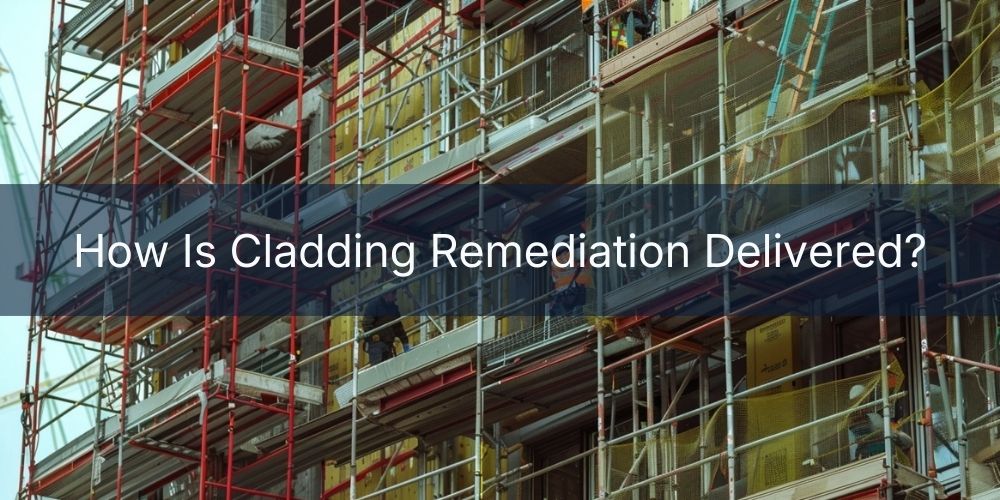
Cladding remediation is delivered as a controlled building safety intervention by sequencing access, strip-out, temporary protection, replacement, continuity correction, and staged verification in a way that reduces external wall risk without creating unmanaged exposure during the works. On occupied UK buildings, unsafe façade conditions cannot be corrected safely through simple panel exchange or ad hoc construction activity. Once removal begins, cavities, sheathing zones, opening perimeters, membranes, barrier lines, and interface conditions can become temporarily vulnerable if the programme is not controlled around phasing, protection, replacement readiness, and concealed-works inspection. A controlled building safety intervention therefore differs from ordinary façade construction because the method of delivery is part of the safety logic of the works, not just the means by which the works are carried out. By aligning phased remediation zones, safe access and protection controls, coordinated strip-out and rebuild sequencing, continuity-critical installation control, and staged inspection before closure, Cladding Remediation delivers cladding remediation in a way that manages short-term delivery risk while correcting long-term safety-critical wall conditions.
- Cladding Remediation phases the intervention by elevation, zone, and interface dependency so safety-critical wall conditions are corrected without uncontrolled façade exposure.
- Cladding Remediation mobilises access, exclusion, and temporary protection controls so the unsafe wall can be opened and corrected without creating unmanaged interim risk.
- Cladding Remediation coordinates strip-out with replacement readiness so exposed wall zones are not left incomplete, unstable, or weather-vulnerable during the intervention.
- Cladding Remediation rebuilds the external wall in controlled sequence so corrected layers, barriers, stopping, and interfaces are installed as one continuous safety-critical assembly.
- Cladding Remediation integrates staged inspection and evidence capture so concealed and exposed corrective works are reviewed while they remain visible, not assumed after completion.
These delivery controls produce the following building safety intervention outcomes:
- Phased intervention sequencing → limits uncontrolled exposure across the façade → occupied-building safety risk is better controlled during the works.
- Access, exclusion, and temporary protection controls → stabilise working and exposed conditions → strip-out and replacement do not introduce unmanaged short-term hazards.
- Strip-out linked to replacement readiness → prevents open-ended exposed wall conditions → the intervention remains controlled from removal through rebuild.
- Controlled rebuild sequencing → restores continuity across corrected wall layers and interfaces → the façade is not rebuilt as disconnected or misaligned parts.
- Staged inspection and evidence capture → verify safety-critical corrections before closure → concealed and visible intervention works are not left unproven.
Each of these delivery controls matters because a controlled building safety intervention is defined not only by the defects it corrects, but by how external wall risk is contained while the unsafe façade is opened, exposed, rebuilt, and evidentially closed out.
1. Phased Elevation Sequencing Controls How Safety-Critical Risk Is Opened and Corrected
Cladding remediation is delivered as a controlled building safety intervention because external wall risk usually has to be opened and corrected in phased elevation zones rather than through unrestricted full-façade strip-out. Different parts of the wall assembly can carry different defect profiles, access constraints, replacement dependencies, and continuity-critical junction conditions at the same time. Openings, slab edges, balconies, parapets, corners, penetrations, and transition zones may all require one corrective activity to be completed before another can proceed safely. Cladding Remediation therefore defines progression order, zone boundaries, interface dependencies, and handover logic before invasive works begin. This matters because sequencing is not just a programme issue. It is one of the primary controls that determines whether the unsafe wall can be opened and corrected without creating unmanaged interim risk.
2. Safe Access, Exclusion Zones, and Temporary Protection Control Interim Exposure During the Works
Cladding remediation is delivered as a controlled building safety intervention because the unsafe wall cannot be opened safely without controlled access systems, protected working boundaries, and temporary protective measures. Scaffold access, exclusion zones, protected pedestrian areas, material control routes, temporary weatherproofing, protected openings, and local stability measures are part of the intervention itself rather than secondary preliminaries. During strip-out, exposed cavities, sheathing, membranes, and interface lines can become vulnerable to weather, instability, uncontrolled access, or accidental disturbance if these controls are weak. Cladding Remediation therefore mobilises access, exclusion, and temporary protection as direct interim-risk controls that allow the façade to be opened and corrected without introducing new unmanaged hazards during delivery.
3. Strip-Out Must Be Sequenced Against Replacement Readiness and Temporary Closure Logic
Cladding remediation is delivered as a controlled building safety intervention because unsafe materials cannot simply be removed without controlling what will immediately replace them and how exposed conditions will be managed in between. Strip-out can reveal concealed defects, open cavity zones, expose barrier lines, interrupt membranes, and leave interface conditions vulnerable at weather-critical and safety-critical locations. If replacement readiness is not aligned with removal sequencing, the building can be left with incomplete, exposed, or weakened façade zones during the works. Cladding Remediation therefore links strip-out to replacement availability, temporary closure logic, interface correction sequencing, and local protection measures so each wall zone moves through a defined intervention path rather than an open-ended construction gap. This matters because controlling the period between removal and rebuild is itself part of controlling building safety risk.
4. Rebuild Sequencing Must Restore the Wall as One Continuous Safety-Critical Assembly
Cladding remediation is delivered as a controlled building safety intervention because the rebuild phase has to restore the external wall as one continuous safety-critical assembly rather than as a set of separately installed parts. Corrected build-ups can include outer materials, insulation, subframe elements, cavity barriers, fire stopping, membranes, sheathing, fixings, and junction details that all depend on compatibility, geometry, tolerance control, and installation order. If those elements are installed without coordinated sequencing, the wall can retain interface weakness, concealed bypass conditions, misalignment, or discontinuity even where the major components are technically present. Cladding Remediation therefore rebuilds the wall through controlled sequence, compatibility checks, and continuity-critical installation control so the corrected façade functions as one integrated safety system rather than a partially corrected arrangement of components.
5. Concealed Safety-Critical Works Must Be Inspected and Evidenced Before Closure
Cladding remediation is delivered as a controlled building safety intervention because some of the most important safety-critical conditions are visible only during limited stages of the works and must be inspected before they are closed up. Cavity barriers, fire stopping, hidden interfaces, membrane continuity, temporary exposure conditions, and replacement sequencing outcomes all need staged review while the assembly remains open and observable. If inspection and evidence capture are left until the end of the programme, concealed corrective work may no longer be reviewable in a reliable way. Cladding Remediation therefore integrates staged inspection, photographic evidence, installation checks, traceability capture, and as-built recording into delivery itself so the intervention remains verifiable at the point where safety-critical conditions are actually being corrected. This matters because a building safety intervention has to produce not only a rebuilt wall, but an evidenced record of how concealed risk was controlled before closure.
What Building Safety Risks Does Cladding Remediation Reduce?
Cladding remediation reduces building safety risk by correcting the external wall conditions that can increase fire spread potential, leave concealed cavity routes unresolved, weaken interface integrity, create occupied-building exposure during unsafe wall conditions, and prevent the façade from functioning as a verifiable safety-critical assembly on UK buildings. Building safety risk is not limited to visible cladding panels. On many buildings, the most serious risks sit within the full external wall build-up, including combustible materials, unsafe insulation, missing or defective cavity barriers, incomplete fire stopping, weak junction detailing, and incompatible replacement or legacy components concealed behind the visible façade. Where these conditions remain within the assembly, the building can retain elevated life-safety risk even if surface materials appear intact or partially renewed. By identifying and correcting these conditions through evidence-led investigation, controlled removal, compliant replacement, continuity correction, occupied-building protection measures, and staged verification, Cladding Remediation reduces the principal building safety risks that most often drive external wall intervention on UK buildings.
- Cladding Remediation reduces fire spread risk so unsafe wall conditions do not continue to support rapid façade fire development.
- Cladding Remediation reduces concealed cavity spread risk so hidden routes within the wall build-up are not left unresolved behind renewed visible materials.
- Cladding Remediation reduces interface failure risk so junction conditions at openings, slab edges, balconies, parapets, penetrations, and transitions do not retain concealed safety weakness.
- Cladding Remediation reduces occupied-building delivery risk so unsafe façade conditions can be opened and corrected without creating unmanaged interim exposure during the works.
- Cladding Remediation reduces evidential uncertainty risk so the corrected wall assembly is not left without a reviewable record of what was found, corrected, installed, and verified.
These risk controls produce the following building safety outcomes:
- Fire spread correction → removes or replaces unsafe wall conditions → external wall fire risk is reduced.
- Concealed cavity correction → closes hidden spread pathways within the build-up → residual concealed spread risk is reduced.
- Interface correction → resolves continuity weakness at transitions and junctions → localised façade safety failure is reduced.
- Controlled occupied-building delivery → manages interim exposure during strip-out and rebuild → the intervention does not create unmanaged short-term hazards.
- Staged evidence capture and verification → document corrected safety-critical conditions → the remediated façade is more reviewable and governable as a safety outcome.
Each of these risks affects building safety differently, which is why cladding remediation has to reduce the full pattern of external wall danger across materials, cavities, interfaces, occupied-building delivery conditions, and post-completion evidence rather than treating visible cladding replacement as the whole intervention.
1. Combustible External Wall Materials Increase Façade Fire Spread Risk
Cladding remediation reduces building safety risk because combustible cladding materials, unsafe insulation, and poorly coordinated replacement products can allow flame, heat, and fire development to move more rapidly across the façade than the corrected wall system should permit. The issue is not only that a particular product is present, but that the external wall may continue to behave as a fire-propagating system rather than as a corrected safety-critical envelope. This matters because the façade is part of the building’s wider life-safety condition, not an isolated outer finish. Reducing this risk means removing and replacing the material and system conditions that allow the wall to contribute to fire development rather than resist it.
2. Missing or Defective Cavity Barriers Leave Concealed Fire and Smoke Routes Within the Wall Build-Up
Cladding remediation reduces building safety risk because hidden voids within the wall build-up can allow fire and smoke to move behind the visible façade where cavity barriers are missing, defective, bypassed, misaligned, compressed, or discontinuous. These concealed routes are especially serious because they may remain embedded within the assembly even when exposed outer materials have been altered or renewed. A façade can therefore appear corrected at the surface while still retaining significant hidden spread potential in the cavity zone behind it. Reducing this risk means correcting the concealed barrier conditions that allow fire and smoke movement to remain within the external wall system.
3. Weak Interface Detailing Leaves Openings, Slab Edges, Balconies, and Transitions as Residual Safety Failure Points
Cladding remediation reduces building safety risk because many of the most serious safety-critical weaknesses are concentrated where wall elements meet, stop, turn, penetrate, or change geometry rather than across open wall fields alone. Openings, slab edges, balconies, parapets, corners, penetrations, and transition zones can all retain hidden danger if fire stopping, cavity barriers, membranes, seals, closures, and replacement details do not align correctly across the same junction condition. These locations matter because local interface weakness can preserve residual façade risk even where primary wall materials have been removed and replaced. Reducing this risk means correcting the local conditions where concealed safety weakness most often persists within the external wall system.
4. Uncontrolled Strip-Out and Temporary Exposure Can Create Interim Risk on Occupied Buildings
Cladding remediation reduces building safety risk because unsafe external wall conditions often have to be corrected while the building remains in use and while parts of the façade are being opened, stripped out, temporarily exposed, and rebuilt in phases. During that process, cavities, sheathing zones, opening perimeters, membranes, barrier lines, and junction interfaces can become temporarily vulnerable if access control, temporary protection, exclusion measures, and replacement sequencing are weak. This matters because a building safety intervention must reduce long-term façade risk without creating unmanaged short-term hazards while the unsafe wall is being corrected. Reducing this risk means controlling how the building is protected while the wall is open, not only how it performs after completion.
5. Missing Inspection Records and Closeout Evidence Leave Residual Safety Uncertainty After the Works
Cladding remediation reduces building safety risk because a building can remain safety-uncertain even after physical works are complete if there is no reliable record of what conditions were found, what defects were corrected, what materials were installed, and how concealed safety-critical measures were checked before closure. Scope records, product traceability, cavity barrier photographs, fire-stopping evidence, staged inspections, and coordinated closeout documentation matter because the corrected external wall system must remain reviewable as a safety outcome after completion. If the evidential basis is weak, fragmented, or incomplete, the façade can still carry unresolved safety uncertainty even where substantial remediation has taken place. Reducing this risk means turning the corrected wall assembly into a documented and reviewable safety outcome rather than a rebuilt but only partially evidenced façade.
Have a question about an upcoming project?
What Determines the Scope of Cladding Remediation as a Building Safety Intervention?
The scope of cladding remediation as a building safety intervention is determined by the actual extent, location, and interaction of safety-critical external wall defects within the façade assembly rather than by visible cladding panels alone. A building does not require the same remediation scope simply because it has cladding. Scope is shaped by what intrusive investigation, opening-up records, material identification, cavity barrier checks, fire-stopping findings, interface condition mapping, and wider wall-build-up review show to be present within the external wall system. On some UK buildings, the safety-critical condition may be concentrated within limited façade zones or specific junctions. On others, combustible materials, concealed spread pathways, discontinuous barriers, defective stopping, and weak interface logic may be distributed more widely across elevations, transitions, and connected wall areas. The scope of a building safety intervention is therefore defined by the true defect pattern of the wall assembly, the extent of concealed continuity failure, the relationship between local defects and wider system risk, the agreed fire strategy, and the practical delivery constraints of correcting the unsafe wall on an occupied building. By aligning verified defect evidence, system-depth investigation, fire-strategy requirements, interface concentration, and delivery constraints, Cladding Remediation defines remediation scope as a safety-critical intervention boundary rather than as a surface-level repair area.
- Cladding Remediation defines scope from intrusive opening-up and verified as-built findings so remediation boundaries align with actual external wall defects rather than assumed visible problems.
- Cladding Remediation defines scope from the extent of combustible, incompatible, or unsafe wall materials so the intervention reaches all material conditions that continue to drive façade risk.
- Cladding Remediation defines scope from cavity barrier, fire-stopping, and interface failure patterns so concealed spread pathways are not left outside the remediation boundary.
- Cladding Remediation defines scope from how local defects connect to wider elevations, junctions, and transition zones so isolated correction does not leave system-level safety weakness behind.
- Cladding Remediation defines scope from fire-strategy requirements, occupied-building constraints, and intervention sequencing logic so the remediation boundary can be corrected safely as well as correctly.
These scope-defining factors produce the following building safety intervention outcomes:
- Intrusive findings and as-built verification → reveal the true defect pattern within the wall assembly → remediation targets verified safety-critical conditions rather than assumed façade issues.
- Material extent review → identifies how far unsafe or incompatible build-up conditions continue through the wall system → intervention reaches the material sources of residual risk.
- Barrier, stopping, and interface mapping → shows where concealed continuity failure persists → spread pathways are not left beyond the defined scope.
- Connection analysis across elevations and transitions → reveals where local defects are part of wider façade weakness → the intervention boundary is set at system level rather than patch level.
- Fire-strategy and delivery-constraint review → tests what has to be corrected and how it can be corrected safely → remediation scope is both technically correct and deliverable as a controlled safety intervention.
Each of these scope drivers matters because a building safety intervention is only effective when the remediation boundary reflects the real extent of wall-system risk rather than the limited area of visible damage.
1. Intrusive Opening-Up and As-Built Findings Define the True Intervention Boundary
The scope of cladding remediation as a building safety intervention is determined first by what intrusive opening-up and as-built investigation reveal within the external wall assembly. Visible façade appearance rarely shows the full extent of combustible materials, missing barriers, defective stopping, membrane failure, interface weakness, or legacy replacement issues concealed behind the outer surface. Opening-up establishes what is actually installed, where the defect conditions sit, how the build-up is formed, and whether the wall matches assumptions, historic records, or previous design information. This matters because a safety-led intervention cannot be scoped accurately from surface symptoms alone. The true intervention boundary has to be based on verified wall conditions rather than on what the façade merely appears to be from the outside.
2. The Extent of Unsafe or Incompatible Materials Determines How Far the Scope Must Reach
The scope of cladding remediation as a building safety intervention is determined by how far combustible, incompatible, unsafe, or unverified materials extend through the wall build-up and across connected façade zones. Unsafe material conditions may sit not only in exposed cladding panels, but also in insulation layers, replacement components, support interfaces, or concealed build-up elements behind visible surfaces. Where those materials continue beyond the area of obvious deterioration, limiting the intervention to the visibly affected zone can leave the wall system carrying residual risk. This matters because remediation scope must reach the actual extent of unsafe material conditions rather than stopping at the boundary of cosmetic damage or isolated surface replacement.
3. Cavity Barrier, Fire-Stopping, and Interface Failure Patterns Determine the Spread-Risk Boundary
The scope of cladding remediation as a building safety intervention is determined by the pattern of cavity barrier failure, fire-stopping failure, and interface weakness across the wall assembly. Missing or defective cavity barriers, incomplete fire stopping, and poorly resolved junctions may be concentrated around openings, slab edges, balconies, parapets, penetrations, corners, and transition zones, or they may extend more widely through connected elevations. These conditions matter because concealed spread pathways do not follow the neat visual edges of façade panels. If the remediation boundary is set without understanding where barrier and interface continuity actually fails, hidden risk can remain outside the defined scope. The intervention boundary therefore has to follow the true spread-risk pattern of the wall system rather than the most convenient visible work zone.
4. Local Defects Must Be Tested Against Wider Elevation, Junction, and Transition Continuity
The scope of cladding remediation as a building safety intervention is determined not only by the presence of local defects, but by whether those defects are isolated or part of a wider continuity problem across elevations, junctions, and transitions. A defect found at one opening, parapet, balcony interface, slab edge, or penetration may indicate a repeating condition elsewhere in the same façade build-up or across connected wall zones. This matters because patch correction is only appropriate where the wall condition is genuinely localised. If local failures are part of a repeated or system-level defect pattern, the intervention boundary has to widen accordingly. Scope therefore depends on understanding how individual defect locations connect to the wider external wall assembly.
5. Fire-Strategy Requirements and Occupied-Building Constraints Determine What Can Be Corrected Safely and Coherently
The scope of cladding remediation as a building safety intervention is determined not only by what defects exist, but also by what the agreed fire strategy requires and how the unsafe wall can be corrected safely on an occupied building. Some buildings may allow targeted intervention where the safety-critical condition is tightly bounded and can be corrected without leaving wider system weakness. Others may require broader phased remediation because defect conditions, spread pathways, occupied-building constraints, temporary protection needs, or delivery dependencies mean that isolated correction would be unsafe, incoherent, or incomplete. This matters because the scope of a building safety intervention has to be both technically correct and practically deliverable. A remediation boundary is only valid if it reflects the real wall risk and the conditions under which that risk can be safely removed.
When Should a Building Be Assessed for Cladding Remediation as a Building Safety Intervention?
A UK building should be assessed for cladding remediation as a building safety intervention when the external wall can no longer be relied on as a safe, continuous, and evidentially understood assembly. Assessment is not triggered by visible cladding panels alone. On many UK buildings, the strongest reasons for intervention sit within the wider wall build-up behind and around the façade, including combustible cladding materials, unsafe insulation, missing or defective cavity barriers, incomplete fire stopping, weak interface detailing, incompatible replacement components, and poor evidential understanding of what is actually installed. Where these conditions remain unknown, unverified, unsafe, discontinuous, poorly coordinated, or unsupported by reliable records, the building can retain concealed spread risk, residual façade weakness, unresolved safety uncertainty, and wider life-safety exposure even if surface defects appear limited or earlier visible works have already been carried out. On occupied buildings, delayed assessment can also increase interim risk by prolonging exposure to unresolved wall defects, repeat access requirements, temporary protection demands, phased strip-out constraints, and reactive corrective works across live elevations. Cladding Remediation assesses external wall systems as complete safety-critical assemblies using evidence-led review of as-built build-ups, concealed defect locations, cavity barrier continuity, fire-stopping continuity, interface formation, material compatibility, delivery constraints, and closeout evidence aligned to the agreed fire strategy and remediation strategy. This allows cladding remediation decisions to be made against verified wall conditions rather than isolated visible defects or incomplete assumptions. Where building safety risk is present or cannot be ruled out from reliable evidence, cladding remediation should be assessed as a building safety intervention rather than deferred as a surface-level maintenance issue.