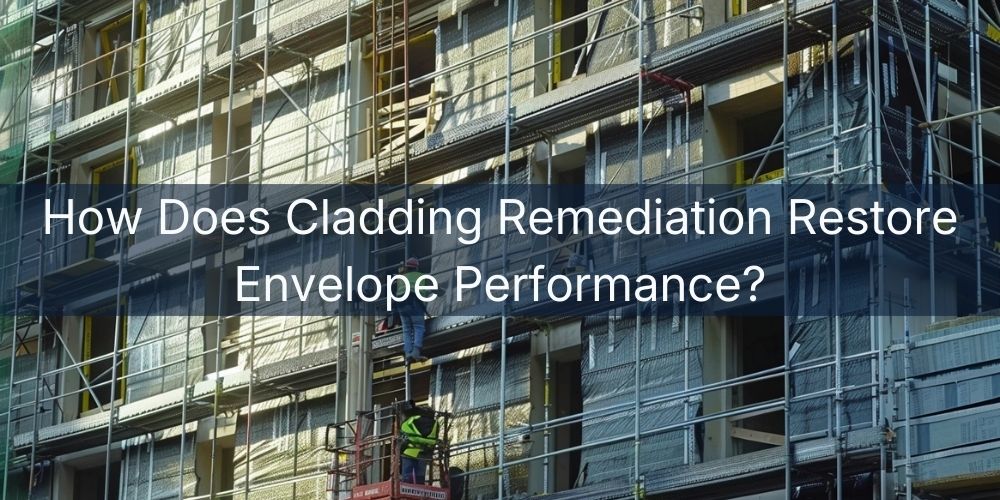
Cladding remediation restores envelope performance by correcting external wall conditions that compromise how the building envelope protects against weather, moisture ingress, uncontrolled air movement, thermal loss, and façade deterioration on UK buildings. Cladding Remediation delivers cladding remediation as an envelope-restoration process for buildings where the external wall assembly has been weakened by defective materials, missing barriers, degraded membranes, poorly sealed interfaces, or discontinuous insulation layers. The building envelope functions as the environmental separation system of the building, and its performance depends on continuity across outer finishes, cavities, membranes, insulation lines, air barriers, and interface details. Where those elements are defective or incorrectly assembled, the envelope may lose its ability to resist water penetration, control air leakage, maintain thermal continuity, and protect internal building conditions. By aligning evidence-led investigation, controlled removal of defective façade components, installation of compliant replacement build-ups, restoration of junction and barrier continuity, and verifiable closeout documentation, Cladding Remediation delivers cladding remediation that restores the functional performance of the building envelope on UK buildings.
- Cladding Remediation identifies envelope performance failures using evidence-led investigation so corrective works target the real causes of envelope degradation.
- Cladding Remediation removes defective façade materials and degraded system components so compromised layers are not retained within the remediated envelope.
- Cladding Remediation installs compliant replacement build-ups so the external wall assembly regains its ability to resist weather, control moisture, and maintain thermal continuity.
- Cladding Remediation restores sealing, barrier continuity, and interface detailing so air, moisture, and heat pathways are corrected across the envelope.
- Cladding Remediation integrates inspection evidence and closeout documentation so restored envelope performance can be verified and governed.
These cladding remediation decisions produce the following envelope performance outcomes:
- Evidence-led façade investigation → identifies real envelope performance failures → remediation targets the true causes of water, air, and thermal weakness.
- Removal of defective materials and degraded components → eliminates compromised layers within the wall assembly → envelope durability and resilience are improved.
- Compliant replacement build-ups → restore insulation, weathering, and protection layers → thermal and moisture performance are improved.
- Verified sealing and barrier continuity → reduce uncontrolled air and moisture movement → envelope integrity is strengthened.
- QA evidence capture and closeout documentation → provide a verifiable restoration record → long-term maintenance and building assurance are supported.
Each of these envelope restoration outcomes is produced through specific investigation, removal, replacement, continuity-correction, and assurance processes, which are set out below.
1. Cladding Remediation Identifies Envelope Performance Failures Through Investigation
Cladding Remediation identifies envelope performance failures through investigation because the causes of envelope degradation often sit within concealed façade layers rather than visible surfaces alone. During mobilisation, Cladding Remediation coordinates intrusive opening-up, records as-built wall build-ups, identifies cladding and insulation materials, checks membranes and barrier placement, and documents interface conditions at windows, balconies, slab edges, parapets, and penetrations. This investigation process reveals where water ingress pathways, air leakage routes, thermal discontinuities, or material failures exist within the external wall assembly. By understanding the true performance condition of the envelope, remediation works can target the defects that undermine environmental protection.
2. Cladding Remediation Removes Defective Envelope Components
Cladding Remediation removes defective envelope components because the building envelope cannot perform effectively while degraded materials remain embedded within the external wall assembly. Defective conditions may include deteriorated cladding panels, degraded membranes, poorly installed insulation, missing seals, or failed interface details that allow water penetration and uncontrolled airflow. Cladding Remediation removes these compromised elements in a controlled sequence so replacement works can restore envelope integrity without leaving hidden weaknesses behind. This removal process resets the envelope structure so performance restoration can be achieved through corrected build-ups.
3. Cladding Remediation Installs Replacement Build-Ups That Restore Envelope Performance
Cladding Remediation installs replacement build-ups that restore envelope performance because the external wall system must regain continuous weather, thermal, and air control layers after defective components are removed. Cladding replacement works may involve new cladding finishes, corrected insulation arrangements, renewed membranes, improved cavity management, and enhanced sealing around openings and structural transitions. Cladding Remediation installs these elements using coordinated sequencing and controlled tolerances so the envelope layers reconnect into a coherent protective shell. This rebuilding process restores the envelope’s ability to maintain internal building conditions and resist environmental exposure.
4. Cladding Remediation Corrects Interface Conditions Across the Envelope
Cladding Remediation corrects interface conditions across the envelope because performance failures frequently occur at junctions rather than across open wall surfaces alone. Windows, doors, balconies, slab edges, parapets, movement joints, and service penetrations are all locations where water ingress, air leakage, and thermal bridging can develop. Cladding Remediation restores sealing continuity, membrane transitions, insulation alignment, and interface detailing at these locations so the envelope performs as a continuous environmental barrier. This interface correction process ensures that restored envelope performance extends beyond the façade surface to the full outer shell of the building.
5. Cladding Remediation Verifies Restored Envelope Performance Through QA Documentation
Cladding Remediation verifies restored envelope performance through quality assurance documentation because envelope restoration outcomes must remain verifiable after works are complete. Inspection records, opening-up findings, material traceability, membrane and sealing photographs, interface documentation, and as-built records are captured throughout the programme so the corrected envelope is supported by a clear evidence trail. Cladding Remediation integrates these assurance processes into delivery so restored performance can be reviewed and governed long after remediation has finished. This verification process supports project sign-off, long-term building maintenance, and continued confidence in the building envelope following cladding remediation.
What Envelope Performance Failures Does Cladding Remediation Correct?
Cladding remediation corrects envelope performance failures by removing, replacing, or resolving the external wall defects that prevent the building envelope from resisting water ingress, controlling air leakage, maintaining thermal continuity, preserving weathering continuity, and sustaining interface continuity on UK buildings. Envelope performance failure is not limited to visible cladding panels. On many buildings, the most serious failures sit within the full wall build-up and at the points where envelope layers start, stop, turn, connect, or pass around other elements. Where these failures remain within the assembly, the external wall can lose continuity across its moisture-control, air-control, thermal, weathering, and junction functions even if the outer façade appears intact. By identifying and correcting these conditions through evidence-led investigation, controlled removal, compliant replacement works, continuity correction, and traceable closeout, Cladding Remediation corrects the envelope performance failures that most often prevent the external wall from functioning as a reliable environmental barrier.
- Cladding Remediation corrects water ingress failure so concealed moisture pathways are not left within the wall build-up.
- Cladding Remediation corrects air leakage failure so uncontrolled air movement is not left embedded within the envelope.
- Cladding Remediation corrects thermal continuity failure so heat loss is not concentrated at broken insulation lines and weak transitions.
- Cladding Remediation corrects weathering continuity failure so the outer wall build-up retains continuous resistance to rain, wind, and exposure.
- Cladding Remediation corrects interface continuity failure so localised envelope weakness is not left at openings, slab edges, balconies, parapets, penetrations, corners, and transitions.
These corrections produce the following envelope performance outcomes:
- Water ingress correction → closes concealed moisture pathways → resistance to water penetration is improved.
- Air leakage correction → restores air-control continuity → uncontrolled air movement through the wall system is reduced.
- Thermal continuity correction → reconnects broken thermal lines → localised heat loss and thermal weakness are reduced.
- Weathering continuity correction → restores continuous external protection → resistance to exposure across the wall build-up is improved.
- Interface continuity correction → resolves localised transition failure → envelope performance is strengthened where systems meet.
Each of these failures affects envelope performance in a different way, which is why cladding remediation must correct the full pattern of external wall weakness rather than treating visible cladding as the only source of performance loss.
1. Water Ingress Failure
Cladding remediation corrects water ingress failure because the building envelope cannot perform as a weather-resisting barrier where water is able to pass through defective cladding joints, failed seals, incomplete flashings, badly terminated membranes, or unresolved junction conditions. On affected buildings, moisture entry often concentrates at openings, parapets, slab edges, penetrations, and transition details where the outer wall build-up loses continuity. These failures can remain concealed behind visible façade surfaces while allowing damp exposure, material degradation, and wider envelope weakness to persist within the wall assembly. Correcting water ingress failure restores the external wall’s ability to resist rainwater penetration through the full build-up rather than only across the visible surface.
2. Air Leakage Failure
Cladding remediation corrects air leakage failure because envelope performance depends on continuous air-control layers and sealed interface lines across the external wall system. Where membranes are discontinuous, seals are incomplete, interfaces are poorly resolved, or penetrations are not properly closed, uncontrolled air movement can pass through the wall build-up and undermine environmental separation. These failures often concentrate at window perimeters, slab edges, service penetrations, parapets, and movement zones where multiple envelope layers have to connect correctly. Correcting air leakage failure restores the continuity needed for the external wall to function as a controlled air barrier rather than a wall assembly with hidden leakage paths.
3. Thermal Continuity Failure
Cladding remediation corrects thermal continuity failure because the building envelope cannot maintain consistent thermal performance where insulation lines are broken, compressed, missing, poorly aligned, or interrupted at junction conditions. These failures often occur through the wall depth and at transitions such as slab edges, balconies, openings, parapets, and support interfaces, where the thermal layer is most vulnerable to discontinuity. Where those conditions remain unresolved, the external wall can retain concentrated heat-loss zones and broader thermal weakness even if the façade appears visually complete. Correcting thermal continuity failure restores the continuity of the insulation layer across the wall build-up and its critical transitions.
4. Weathering Continuity Failure
Cladding remediation corrects weathering continuity failure because the external wall must provide continuous resistance to rain, wind, and environmental exposure across the whole façade assembly, not just across isolated panel areas. Weathering failure can arise where outer-layer details, terminations, closures, flashings, copings, or edge conditions are incomplete, degraded, or poorly coordinated with the surrounding build-up. These failures are especially important at parapets, corners, roof edges, penetrations, and perimeter conditions where the outer wall has to turn, stop, or connect to adjoining elements. Correcting weathering continuity failure restores the external wall’s ability to perform as a continuous protective shield against external exposure.
5. Interface Continuity Failure
Cladding remediation corrects interface continuity failure because many of the most serious envelope weaknesses are concentrated where systems meet rather than across open wall areas alone. Windows, doors, slab edges, balconies, parapets, penetrations, movement joints, corners, and transition points can all retain localised failure if membranes, seals, insulation lines, closures, and protective details do not align across the junction. These failures matter because the envelope only performs as intended when continuity is maintained at connections between systems as well as within the wall field. Correcting interface continuity failure restores the building envelope as a connected environmental barrier rather than a set of disconnected façade elements.
Have a question about an upcoming project?
Which Parts of the Building Envelope Are Most Affected by Cladding Remediation?
Cladding remediation most affects the parts of the building envelope where weather resistance, moisture control, air control, thermal continuity, and junction continuity depend on correctly formed external wall layers and interface details. The building envelope is not limited to visible cladding panels. It includes the exposed outer layer, the weathering and moisture-management details around it, the insulation and cavity layers behind it, the concealed membrane and sealing layers within it, and the interface conditions where the wall build-up connects to openings, edges, penetrations, and adjoining elements. Where these parts are defective, discontinuous, degraded, or poorly coordinated, cladding remediation changes how the external wall performs as a continuous protective barrier rather than as isolated façade areas. By identifying the real as-built condition, removing defective materials, correcting concealed weakness, and installing compliant replacement assemblies, Cladding Remediation affects the building envelope at the level of the wall build-up and its critical interface conditions rather than at the visible surface alone.
- Cladding Remediation affects outer cladding layers so the exposed wall face is not left carrying defective external protection.
- Cladding Remediation affects flashings, copings, drips, closures, and other weathering details so rain-shedding continuity is restored across exposed façade conditions.
- Cladding Remediation affects insulation layers and cavity zones so thermal continuity and concealed wall stability are restored through the wall depth.
- Cladding Remediation affects membranes and seals so moisture-control and air-control continuity are not left broken within the build-up.
- Cladding Remediation affects openings, slab edges, balconies, and parapets so continuity is restored where the wall build-up is interrupted by larger interface conditions.
- Cladding Remediation affects penetrations, movement joints, corners, and terminations so continuity is restored where the envelope is pierced, turned, separated, or brought to an end.
These corrections produce the following envelope effects:
- Outer-layer correction → restores exposed wall protection → visible envelope durability is improved.
- Weathering-detail correction → restores rain-shedding continuity → exposure resistance is improved at vulnerable façade edges and transitions.
- Insulation and cavity correction → restores continuity through the wall depth → thermal weakness and concealed instability are reduced.
- Membrane and seal correction → reconnects hidden control layers → moisture and air leakage pathways are reduced.
- Large-interface correction → restores continuity at major wall interruptions → envelope weakness is reduced where larger junctions disrupt the build-up.
- Small-interface correction → restores continuity at penetrations and edge conditions → localised failure points across the outer shell are reduced.
Each of these parts affects envelope performance differently, which is why cladding remediation must correct the full pattern of wall-layer and interface weakness rather than treating visible cladding as the whole envelope.
1. Outer Cladding Layers
Cladding remediation most affects outer cladding layers because they form the exposed outer face of the building envelope and are directly responsible for resisting rain, wind, surface weathering, and day-to-day environmental exposure. This includes the visible cladding panels or façade finish, together with the way those elements are fixed, aligned, jointed, and integrated with the rest of the wall build-up. If the outer cladding layer is deteriorated, displaced, cracked, poorly fitted, incompatible with the supporting system, or unable to perform as intended within the wider assembly, the envelope can lose visible protective function even where concealed layers remain present behind it. Outer-layer defects also matter because they can expose underlying components to moisture, movement, and accelerated degradation. Correcting the outer cladding layer restores the exposed protective face of the external wall system and re-establishes the outer envelope surface as part of a coherent weather-resisting build-up rather than an isolated finish.
2. Flashings, Copings, Drips, Closures, and Other Weathering Details
Cladding remediation most affects flashings, copings, drips, closures, and other weathering details because these parts control how rainwater is shed, diverted, intercepted, and excluded at the locations where the façade stops, turns, steps, or meets another element. These details are especially important at parapets, openings, slab edges, roof-to-wall interfaces, horizontal breaks, perimeter edges, and transition zones where water management depends on formed geometry rather than on flat wall areas alone. If flashings are incomplete, copings are poorly formed, drips are missing, closures are weak, or edge details are degraded or badly coordinated, the envelope can lose continuity at precisely the points where external exposure is most concentrated. These failures can allow moisture entry, staining, material breakdown, and wider deterioration to begin at local edges before spreading into the wall build-up. Correcting these parts restores the façade’s ability to manage rain and environmental exposure through continuous weathering protection rather than through open, weak, or interruption-prone edge conditions.
3. Insulation Layers and Cavity Zones
Cladding remediation most affects insulation layers and cavity zones because these parts control thermal continuity through the wall depth and strongly influence how concealed weakness develops behind the visible façade. The insulation layer affects whether the building envelope can maintain consistent thermal resistance across open wall areas and across transitions, while the cavity zone affects how the wall manages ventilation, drainage, moisture movement, and concealed spread conditions behind outer finishes. If insulation is broken, missing, compressed, displaced, poorly aligned, degraded, or interrupted at support interfaces and junctions, the envelope can retain concentrated thermal weakness even where the outer wall appears complete. If cavity zones are badly managed, blocked, poorly closed, wrongly formed, or left with unresolved concealed defects, the wall assembly can also retain hidden instability behind the visible surface. Correcting these parts restores continuity and stability within the wall build-up so the envelope performs through its full depth rather than only at the outer face.
4. Membranes and Seals
Cladding remediation most affects membranes and seals because these parts maintain hidden moisture-control and air-control continuity behind the visible façade surface. Membranes and sealing lines are critical wherever the wall depends on concealed protective layers to resist water ingress, reduce uncontrolled air movement, and maintain continuity between adjacent components. If membranes terminate badly, laps are incomplete, penetrations are unresolved, seals fail, or concealed protective lines are discontinuous across interfaces, the wall assembly can retain leakage pathways even where outer finishes appear acceptable. These failures are especially important because they often remain embedded within the build-up and can continue to undermine envelope performance after visible defects seem to have been addressed. Correcting membranes and seals restores the concealed continuity that supports moisture resistance and air control across the external wall system rather than leaving the envelope dependent on exposed surface appearance alone.
5. Openings, Slab Edges, Balconies, and Parapets
Cladding remediation most affects openings, slab edges, balconies, and parapets because these are the larger interface conditions where the wall build-up is interrupted, turned, exposed, or connected to adjoining construction. At these locations, multiple envelope layers have to align correctly across a wider and more complex junction area, including outer finishes, insulation lines, membranes, seals, flashings, closures, and protective details. These are also the points where water ingress, air leakage, thermal weakness, and weathering breakdown most often concentrate because the continuity of the wall field is no longer straightforward. Openings introduce perimeter conditions around windows and doors, slab edges interrupt the wall depth and insulation line, balconies create exposed connection zones, and parapets create top-edge weathering conditions that must all be resolved as part of the envelope system. Correcting these parts restores continuity where larger wall interruptions most commonly disrupt envelope performance and where local failure can spread into wider façade weakness.
6. Penetrations, Movement Joints, Corners, and Terminations
Cladding remediation most affects penetrations, movement joints, corners, and termination details because these are the smaller but highly sensitive transition conditions where the envelope is pierced, separated, turned, or brought to an end. Service penetrations interrupt the wall build-up and must be sealed and integrated correctly. Movement joints must allow controlled building movement without losing protective continuity. Corners must maintain continuity as the wall changes direction. Terminations must close the envelope properly where wall systems stop against adjacent elements or at free edges. If these details are incomplete, discontinuous, weak, or poorly coordinated, the wall can retain localised envelope weakness even where larger façade areas perform adequately. These conditions matter because small-scale discontinuities often become the routes through which moisture, air, and wider deterioration begin to affect the assembly. Correcting these parts restores the envelope as a connected external barrier rather than a series of interrupted sections with vulnerable local failure points.
When Should a Building Be Assessed for Cladding Remediation to Restore Envelope Performance?
If a UK building has confirmed or suspected external wall defects, unresolved envelope-performance weakness, or uncertainty around water ingress resistance, air-control continuity, insulation continuity, weathering continuity, or junction continuity, a professional cladding remediation assessment should be carried out before hidden envelope failure is carried forward into wider building deterioration. Envelope performance is not determined by visible cladding panels alone. On many UK buildings, the most serious failures sit within the full wall build-up behind and around the façade, including outer cladding layers, weathering details, flashings, insulation layers, cavity zones, membranes, seals, openings, slab edges, balconies, parapets, penetrations, movement joints, corners, and termination details. Where these conditions remain unknown, defective, discontinuous, degraded, or poorly coordinated, surface-level assumptions can leave water ingress failure, air leakage failure, thermal continuity failure, weathering continuity failure, and interface continuity failure unresolved after visible works are complete. On occupied buildings, delayed action can also increase programme complexity by extending exposure to moisture ingress, repeat access requirements, temporary protection demands, internal disruption, and reactive repair works across live elevations. Cladding Remediation assesses building envelope conditions as complete external wall systems using evidence-led review of as-built build-ups, concealed defect locations, membrane and seal condition, insulation continuity, weathering detail condition, and junction weakness at major and minor interface zones. This allows cladding remediation decisions to be made against verified envelope conditions rather than isolated visible defects or incomplete assumptions. Where required, Cladding Remediation can support the next technically correct step, whether that is intrusive opening-up and scope validation, targeted external wall corrections, or a phased cladding remediation programme designed to restore envelope performance across the wider building. If your building has identified envelope-related façade risk, unresolved external wall defects, missing remediation evidence, or uncertainty around the correct remediation boundary, request a cladding remediation assessment or project scope review to determine the appropriate envelope-restoration pathway.