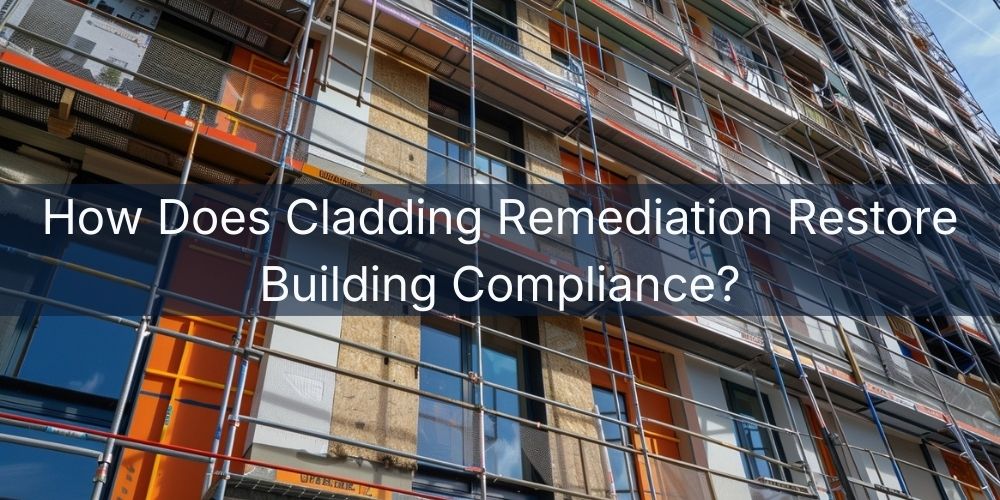
Cladding remediation restores building compliance by identifying, removing, correcting, and replacing unsafe or non-compliant external wall elements in a way that brings the wider wall assembly back into alignment with applicable fire safety, construction, and regulatory requirements on UK buildings. Cladding Remediation delivers cladding remediation as a compliance-led external wall correction service for buildings where visible façade materials are only part of the problem and where non-compliance often extends into concealed cavities, insulation zones, barrier locations, fire stopping interfaces, and installation defects. External wall systems are layered assemblies made up of interdependent components, and compliance cannot be restored through panel replacement alone where combustible materials, discontinuous cavity barriers, defective fire stopping, or poorly resolved junctions remain in place. Where the façade presents regulatory failure or unacceptable risk, remediation must be delivered as a controlled compliance restoration process supported by evidence, defined scope, traceable specification, verified installation, and auditable closeout. By aligning intrusive investigation, defect verification, compliant design intent, removal of non-compliant materials, correction of concealed and visible defects, and documented assurance processes, Cladding Remediation delivers cladding remediation that supports verifiable compliance restoration and long-term building assurance on UK buildings.
- Cladding Remediation defines compliance restoration scope using verified site evidence so remediation addresses actual external wall non-compliance rather than assumed defects.
- Cladding Remediation removes non-compliant façade materials and defective system components so unsafe external wall conditions are not left embedded within the corrected assembly.
- Cladding Remediation installs compliant replacement build-ups so the remediated wall system aligns with the agreed fire strategy, design requirements, and regulatory intent.
- Cladding Remediation corrects cavity barrier, fire stopping, and interface continuity so concealed compliance failures are not left behind after visible works are complete.
- Cladding Remediation integrates inspection records, material traceability, and closeout documentation so compliance restoration can be evidenced, reviewed, and maintained.
These cladding remediation decisions produce the following compliance and assurance outcomes:
- Evidence-led remediation scope → confirms actual non-compliant conditions → corrective works target verified compliance failures.
- Removal of unsafe and defective components → eliminates embedded non-compliant materials → the façade is not left carrying unresolved risk.
- Compliant replacement build-ups → restore the external wall system to an acceptable specification basis → regulatory alignment is improved.
- Verified cavity barrier and fire stopping continuity → close concealed compliance gaps at voids and junctions → hidden spread pathways are reduced.
- QA evidence capture and closeout documentation → create a verifiable compliance audit trail → sign-off, governance, and long-term assurance are supported.
Each of these cladding remediation outcomes is produced by a specific investigation, correction, verification, and assurance process, which is set out below.
1. Cladding Remediation Defines Compliance Restoration Scope Using Evidence-Led Investigation
Cladding Remediation defines compliance restoration scope using evidence-led investigation because building compliance cannot be restored safely where the external wall system is only partially understood or assessed through visible surfaces alone. During mobilisation, Cladding Remediation coordinates intrusive opening-up, records as-built build-ups, identifies material types, confirms insulation configuration, checks cavity barrier presence and orientation, and documents fire stopping conditions at critical interfaces linked to the affected façade zones. This investigation process is used to distinguish cosmetic issues from true compliance failures and to define remediation boundaries around verified defects rather than assumptions. Evidence-led scope definition ensures cladding remediation is directed at the actual external wall conditions that prevent the building from meeting the intended compliance position.
2. Cladding Remediation Removes Non-Compliant Materials and Defective System Elements
Cladding Remediation removes non-compliant materials and defective system elements because compliance cannot be restored where unsafe façade components remain embedded within the external wall assembly. Non-compliant conditions may include combustible cladding materials, unsafe insulation, missing or defective cavity barriers, incomplete fire stopping, incompatible replacement elements, or poorly executed interface details. Cladding Remediation removes these defective components in a controlled sequence so the corrected assembly is not built around legacy failure points. This removal process ensures compliance restoration is based on elimination of verified non-compliant conditions rather than concealment of them behind new finishes.
3. Cladding Remediation Installs Compliant Replacement Build-Ups Aligned With Design Intent
Cladding Remediation installs compliant replacement build-ups aligned with design intent because restoring building compliance requires more than material substitution at the outer face of the façade. Once unsafe components are removed, the replacement assembly must be rebuilt as a coherent system across panels, insulation, support structure, cavity zones, membranes, and junction interfaces. Cladding Remediation installs replacement build-ups using compatible materials, controlled sequencing, and coordinated interface detailing so the remediated wall system reflects the agreed fire strategy and technical design basis. This replacement methodology supports a compliance outcome grounded in system performance rather than isolated product change.
4. Cladding Remediation Corrects Concealed Compliance Failures at Cavities and Interfaces
Cladding Remediation corrects concealed compliance failures at cavities and interfaces because many of the most serious external wall defects are hidden behind visible façade materials and remain capable of undermining compliance after panel replacement alone. Cavity barriers may be absent, discontinuous, misaligned, or bypassed, while fire stopping at openings, slab edges, penetrations, and junctions may be incomplete or broken across complex interface geometry. Cladding Remediation restores cavity barrier layout, fire stopping continuity, and interface coordination so concealed compliance failures are corrected alongside visible façade works. This continuity-correction process ensures the remediated system does not remain non-compliant at the points where fire spread risk is often concentrated.
5. Cladding Remediation Integrates QA Evidence and Closeout Documentation to Verify Compliance Restoration
Cladding Remediation integrates quality assurance evidence and closeout documentation to verify compliance restoration because remediation on UK buildings must be auditable, reviewable, and capable of supporting long-term governance after works are complete. Inspection activity, photographic records, material traceability, installation checks, and as-built evidence are captured throughout the programme so compliance is demonstrated through a live evidence trail rather than reconstructed at the end. Cladding Remediation records opening-up findings, removal extents, replacement materials, cavity barrier locations, fire stopping evidence, and inspection outcomes as works progress. This integrated assurance approach produces a clear compliance audit trail that supports review, sign-off, future management, and ongoing building assurance following cladding remediation.
What Non-Compliant External Wall Conditions Does Cladding Remediation Correct?
Cladding remediation corrects non-compliant external wall conditions by removing, replacing, or resolving the material, barrier, fire-stopping, and interface defects that prevent the wall assembly from meeting the required safety and performance basis on UK buildings. Non-compliance is not limited to visible cladding panels. On many buildings, the most serious compliance failures sit within combustible cladding, unsafe insulation, missing or defective cavity barriers, incomplete fire stopping, poorly resolved interface detailing, incompatible replacement elements, and undocumented wall build-ups. Where these conditions remain within the assembly, the façade can retain concealed compliance gaps even after visible works are carried out. By identifying and correcting these conditions through evidence-led investigation, controlled removal, compliant replacement works, continuity correction, and traceable closeout, Cladding Remediation corrects the external wall failures that most often prevent verifiable compliance restoration.
- Cladding Remediation corrects combustible cladding and unsafe insulation so non-compliant material conditions are removed from the wall build-up.
- Cladding Remediation corrects missing or defective cavity barriers so concealed compliance gaps do not remain within cavity zones.
- Cladding Remediation corrects incomplete or poorly coordinated fire stopping so fire and smoke control is not lost at openings, slab edges, penetrations, and other interfaces.
- Cladding Remediation corrects defective interface detailing and incompatible replacement components so localised non-compliance is not left embedded where systems meet.
- Cladding Remediation corrects undocumented or unverified wall conditions so compliance restoration is based on verified build-up evidence rather than assumption.
These corrections produce the following compliance outcomes:
- Combustible material correction → removes unsafe wall materials → material non-compliance is reduced.
- Cavity barrier correction → restores required protective interruption within concealed voids → hidden cavity non-compliance is reduced.
- Fire stopping correction → restores continuity at openings and penetrations → concealed fire-control non-compliance is reduced.
- Interface and component correction → resolves defects where systems connect → localised junction non-compliance is reduced.
- Build-up verification and correction → aligns remediation with actual wall conditions → undocumented compliance gaps are reduced.
Each of these conditions creates non-compliance in a different way, which is why cladding remediation must correct the full pattern of external wall failure rather than treating visible surface replacement as the whole compliance solution.
1. Combustible Cladding and Unsafe Insulation
Cladding remediation corrects combustible cladding and unsafe insulation because material non-compliance can sit within both the outer façade layer and the concealed wall build-up behind it. Where unsafe materials remain within the assembly, the building can retain a wall system that does not align with the required fire and performance basis even if surface works have taken place. Correcting these conditions is essential because compliance depends on the actual material composition of the wall, not on appearance alone.
2. Missing or Defective Cavity Barriers
Cladding remediation corrects missing or defective cavity barriers because concealed voids can remain non-compliant where required interruptions are absent, badly fitted, discontinuous, or bypassed. These failures are often hidden behind finishes and can remain embedded within the wall build-up unless they are specifically identified and corrected. Restoring cavity barrier continuity is therefore central to correcting concealed compliance failure within the façade assembly.
3. Incomplete or Defective Fire Stopping
Cladding remediation corrects incomplete or defective fire stopping because fire and smoke control can fail at openings, slab edges, corners, penetrations, and other interface conditions even where visible wall areas appear corrected. Missing, incomplete, or poorly installed fire stopping can leave the external wall assembly non-compliant at the locations where fire spread risk is often concentrated. Correcting these conditions is essential to restoring compliance across the wider wall system rather than only within open façade areas.
4. Defective Interface Detailing and Incompatible Components
Cladding remediation corrects defective interface detailing and incompatible components because localised non-compliance often concentrates where systems meet, terminate, or change geometry. Poorly resolved junctions, incompatible replacement elements, and weak detailing around openings, balconies, parapets, penetrations, and transitions can leave the façade non-compliant even where primary materials appear acceptable. Correcting these conditions is necessary because compliance depends on coordinated system performance at junctions as well as within the wall field.
5. Undocumented or Unverified Wall Build-Ups
Cladding remediation corrects undocumented or unverified wall build-ups because compliance cannot be restored on the basis of assumptions about what is present within the assembly. If the actual wall composition, barrier arrangement, fire stopping condition, or interface build-up is unknown or unsupported by evidence, the building can retain unresolved compliance uncertainty even after physical works are undertaken. Correcting this condition requires intrusive verification, traceable records, and remediation aligned to the real as-built wall system.
Have a question about an upcoming project?
When Should a Building Be Assessed for Cladding Remediation to Restore Building Compliance?
A UK building should be assessed for cladding remediation to restore building compliance when the external wall can no longer be relied on as a compliant, evidence-backed, and safely coordinated assembly. Compliance is not determined by visible cladding panels alone. On many buildings, the strongest reasons for intervention sit within the wider wall build-up behind and around the façade, including combustible cladding materials, unsafe insulation, missing or defective cavity barriers, incomplete fire stopping, poorly resolved interface detailing, incompatible replacement elements, and undocumented or unverified wall conditions. Where these conditions remain unknown, unsafe, discontinuous, poorly coordinated, or unsupported by reliable records, the building can retain concealed compliance failure even if surface defects appear limited or earlier visible works have already been carried out. On occupied buildings, delayed assessment can also increase project complexity by extending exposure to unresolved external wall defects, repeat access requirements, temporary protection demands, and reactive corrective works across live elevations. Cladding Remediation assesses external wall systems as complete compliance-critical assemblies using evidence-led review of as-built build-ups, concealed defect locations, cavity barrier continuity, fire-stopping continuity, interface formation, material compatibility, and closeout evidence aligned to the agreed fire strategy and remediation strategy. This allows cladding remediation decisions to be made against verified wall conditions rather than isolated visible defects or incomplete assumptions. If your building has identified external wall non-compliance, unresolved façade defects, missing compliance evidence, or uncertainty around the correct remediation boundary, request a cladding remediation assessment or project scope review to determine the appropriate compliance-restoration pathway.