
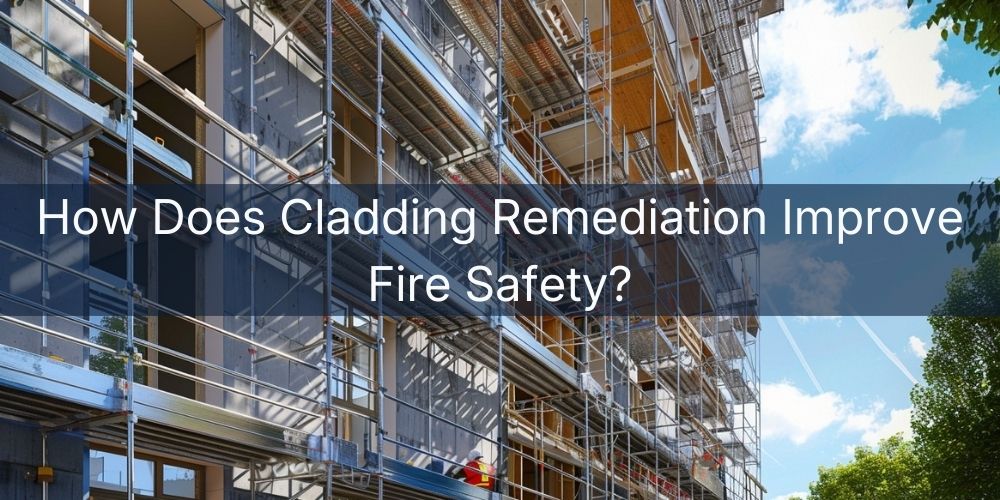
Cladding remediation improves fire safety by identifying, removing, correcting, and replacing external wall conditions that increase the likelihood of fire spread across building façades or through concealed cavity pathways on UK buildings. Cladding Remediation delivers cladding remediation as a fire safety improvement process for buildings where façade risk is often driven by combustible materials, missing or discontinuous cavity barriers, defective fire stopping, and poorly coordinated junction interfaces rather than visible cladding panels alone. External wall systems are layered assemblies that include cladding materials, insulation, support structures, membranes, cavities, barriers, and interface details, all of which influence how fire and smoke may travel across or within the building envelope. Where these elements are incorrectly configured or composed of unsafe materials, the façade can create conditions that accelerate external fire spread or allow fire to bypass compartmentation. By aligning evidence-led investigation, removal of unsafe materials, installation of compliant replacement build-ups, correction of cavity barrier and fire stopping continuity, and verifiable closeout documentation, Cladding Remediation delivers cladding remediation that reduces façade fire spread potential and improves the overall fire safety performance of the external wall system on UK buildings.
- Cladding Remediation identifies fire safety risk using evidence-led investigation so remediation targets verified fire spread pathways rather than visible façade elements alone.
- Cladding Remediation removes combustible or unsafe façade components so materials that contribute to external fire spread are eliminated from the external wall assembly.
- Cladding Remediation installs compliant replacement build-ups so the remediated external wall system aligns with the agreed fire strategy and material safety expectations.
- Cladding Remediation restores cavity barrier and fire stopping continuity so concealed routes for fire and smoke movement are reduced.
- Cladding Remediation integrates inspection evidence and closeout documentation so fire safety improvements can be verified, reviewed, and governed.
These cladding remediation decisions produce the following fire safety outcomes:
- Evidence-led façade investigation → confirms real fire spread drivers → remediation scope targets verified fire safety hazards.
- Removal of combustible or unsafe materials → eliminates key contributors to façade fire spread → external wall fire load and ignition risk are reduced.
- Compliant replacement build-ups → introduce safer materials and system configuration → façade fire performance is improved.
- Verified cavity barrier and fire stopping continuity → close concealed cavity pathways → fire and smoke spread routes are reduced.
- QA evidence capture and closeout documentation → provide a verifiable fire safety audit trail → compliance review and building assurance are supported.
Each of these fire safety outcomes is produced through specific investigation, removal, replacement, continuity-correction, and assurance processes, which are set out below.
1. Cladding Remediation Identifies Fire Safety Risk Through Evidence-Led Investigation
Cladding Remediation identifies fire safety risk through evidence-led investigation because façade fire behaviour cannot be understood or corrected through visual inspection alone. During mobilisation, Cladding Remediation coordinates intrusive opening-up, identifies cladding and insulation materials, confirms cavity barrier presence and orientation, and documents fire stopping conditions at openings, slab edges, penetrations, and interface zones. This investigation establishes where combustible materials or defective barrier conditions may enable external fire spread or allow fire to move within concealed cavity spaces. By identifying these risk conditions before remediation begins, the scope of works can target the real drivers of façade fire risk rather than surface-level symptoms.
2. Cladding Remediation Removes Combustible and Unsafe Façade Materials
Cladding Remediation removes combustible and unsafe façade materials because fire safety cannot be improved while materials capable of accelerating fire spread remain embedded within the external wall system. Unsafe conditions may include combustible cladding panels, inappropriate insulation, incompatible replacement elements, or other materials that increase façade fire load. Cladding Remediation removes these components in a controlled sequence so the wall assembly can be corrected without leaving hazardous materials behind. This removal process reduces the potential for fire to spread rapidly across the façade surface or within concealed layers of the external wall assembly.
3. Cladding Remediation Installs Compliant Replacement Build-Ups With Improved Fire Performance
Cladding Remediation installs compliant replacement build-ups with improved fire performance because removing unsafe materials alone does not guarantee a safer façade system. Replacement works may involve non-combustible cladding materials, revised insulation configurations, corrected support systems, improved membranes, and coordinated junction detailing around openings, balconies, slab edges, and penetrations. Cladding Remediation installs these replacement assemblies using compatible sequencing and controlled tolerances so the external wall system functions as a coherent structure aligned with the agreed fire strategy. This replacement process ensures that the façade is rebuilt around safer material and system conditions rather than simply altered in appearance.
4. Cladding Remediation Restores Cavity Barrier and Fire Stopping Continuity
Cladding Remediation restores cavity barrier and fire stopping continuity because concealed cavity pathways are one of the most significant contributors to façade fire spread. Cavity barriers may be missing, misaligned, incorrectly installed, or bypassed at interface points such as windows, slab edges, parapets, and service penetrations. Fire stopping at these locations may also be incomplete or degraded. Cladding Remediation installs or corrects these barrier systems to restore continuity across cavities and junction interfaces so fire and smoke cannot travel unchecked through the façade assembly. This continuity correction is essential for reducing hidden fire spread routes within the external wall system.
5. Cladding Remediation Verifies Fire Safety Improvements Through QA Evidence
Cladding Remediation verifies fire safety improvements through quality assurance evidence because façade safety improvements must remain auditable after the remediation programme is complete. Inspection records, opening-up findings, material traceability, cavity barrier photographs, fire stopping documentation, and as-built records are captured throughout the works so the corrected façade is supported by a clear evidence trail. Cladding Remediation integrates these assurance processes into delivery rather than relying on post-completion reconstruction of evidence. This verification process supports compliance review, project sign-off, and long-term building assurance by demonstrating how identified façade fire safety risks were corrected through the remediation works.
What Fire Safety Defects Does Cladding Remediation Correct?
Cladding remediation corrects fire safety defects by identifying and resolving the external wall conditions that allow fire and smoke to spread across façades or through concealed cavity routes on UK buildings. The main defects usually include combustible cladding materials, combustible insulation, missing or defective cavity barriers, incomplete fire stopping, and poorly coordinated junction interfaces. These defects can sit within visible façade elements or concealed layers of the external wall system, which is why fire safety risk cannot be judged by surface appearance alone. By investigating the wall build-up, removing unsafe materials, correcting barrier and stopping continuity, and installing compliant replacement assemblies, Cladding Remediation corrects the defects that materially increase façade fire spread risk.
- Cladding Remediation corrects combustible cladding defects so unsafe façade materials are removed from the external wall system.
- Cladding Remediation corrects combustible insulation defects so hidden layers that increase fire load are eliminated or replaced.
- Cladding Remediation corrects cavity barrier defects so concealed fire and smoke routes are properly interrupted.
- Cladding Remediation corrects fire stopping defects so openings, slab edges, and penetrations do not permit uncontrolled fire movement.
- Cladding Remediation corrects junction and interface defects so transitions between façade elements do not create local fire spread weaknesses.
These defect corrections produce the following fire safety effects:
- Combustible cladding correction → removes unsafe outer façade materials → external fire spread potential is reduced.
- Combustible insulation correction → reduces hidden fire load within the wall build-up → concealed fire propagation risk is lowered.
- Cavity barrier correction → restores interruption points within concealed voids → cavity fire and smoke travel are restricted.
- Fire stopping correction → seals vulnerable openings and penetrations → uncontrolled spread through interfaces is reduced.
- Junction and interface correction → improves continuity at critical transition points → local fire bypass routes are reduced.
Each defect affects façade fire safety in a different way, so cladding remediation must correct them individually rather than treating the external wall as a single generic cladding issue.
1. Combustible Cladding Defects
Cladding remediation corrects combustible cladding defects because unsafe outer façade materials can contribute directly to external fire spread. Where cladding panels or rainscreen elements perform poorly under fire exposure, they can increase the speed and severity of flame spread across the building envelope. Cladding Remediation identifies and removes these unsafe cladding materials so the façade no longer relies on products that materially increase external fire risk.
2. Combustible Insulation Defects
Cladding remediation corrects combustible insulation defects because façade fire risk is not limited to the visible outer surface. Insulation within the external wall build-up can increase hidden fire load and worsen fire development within concealed layers if the product is unsuitable for the wall configuration. Cladding Remediation removes or replaces unsafe insulation so the corrected build-up does not retain concealed materials that undermine fire safety performance.
3. Cavity Barrier Defects
Cladding remediation corrects cavity barrier defects because concealed voids can allow fire and smoke to travel rapidly unless they are properly interrupted. Cavity barriers may be missing, misaligned, poorly fitted, discontinuous, or absent at critical locations such as around openings, slab edges, and compartment lines. Cladding Remediation identifies and corrects these defects so concealed fire spread pathways are reduced within the remediated external wall assembly.
4. Fire Stopping Defects
Cladding remediation corrects fire stopping defects because façade fire spread often occurs at openings, penetrations, and structural interfaces rather than through flat wall areas alone. Defective fire stopping around windows, doors, slab edges, and service penetrations can allow fire and smoke to move through the façade build-up where continuity is lost. Cladding Remediation restores fire stopping at these vulnerable points so local weaknesses do not compromise the fire safety of the wider wall system.
5. Junction and Interface Defects
Cladding remediation corrects junction and interface defects because many façade fire safety failures occur where one element meets another. Window perimeters, balconies, parapets, base details, movement joints, and service interfaces can all create fire spread weaknesses if materials and protection measures are not properly coordinated. Cladding Remediation corrects these junction conditions so the external wall system performs as a continuous fire safety assembly rather than as disconnected parts.
Have a question about an upcoming project?
Why Are Cavity Barriers and Fire Stopping So Important in Cladding Remediation?
Cavity barriers and fire stopping are important in cladding remediation because they help stop fire and smoke from moving through concealed parts of the external wall system. On UK buildings, façade fire risk is often driven not only by unsafe materials, but by missing cavity barriers, incomplete fire stopping, and weak interface detailing around openings, slab edges, balconies, parapets, and penetrations. These concealed conditions can allow fire to bypass the visible façade surface and travel through hidden routes within the wall build-up. By identifying these defects through investigation, correcting continuity, and verifying installation during the works, Cladding Remediation improves fire safety by reducing concealed façade spread pathways.
- Cladding Remediation restores cavity barrier continuity so concealed voids do not remain open fire and smoke routes.
- Cladding Remediation corrects fire stopping defects so openings, penetrations, and junctions do not allow fire to bypass protected lines.
- Cladding Remediation inspects concealed barrier and stopping conditions so hidden spread routes are identified before the façade is closed up.
- Cladding Remediation coordinates barriers and fire stopping with the replacement build-up so the corrected wall system functions as a continuous fire safety assembly.
- Cladding Remediation verifies barrier and fire stopping installation so concealed protection measures are evidenced after completion.
These corrections produce the following fire safety effects:
- Restored cavity barrier continuity → interrupts concealed façade voids → hidden fire and smoke spread routes are reduced.
- Corrected fire stopping → closes vulnerable openings and penetrations → local fire bypass routes are reduced.
- Inspection of concealed protection measures → confirms real defect conditions → remediation scope targets verified spread pathways.
- Coordinated integration with the replacement build-up → aligns fire protection with the corrected wall assembly → façade fire performance is strengthened.
- Verification and closeout evidence → confirm concealed measures were installed correctly → fire safety assurance is supported.
These protective measures matter because façade fire spread is often driven by concealed continuity failures rather than by the visible outer surface alone.
1. Cavity Barriers Control Concealed Fire Spread
Cavity barriers are important in cladding remediation because concealed voids behind cladding can allow fire and smoke to travel rapidly if they are left uninterrupted. These cavities may sit behind rainscreen panels, around insulation layers, and at structural or opening interfaces within the external wall system. Where cavity barriers are missing, misaligned, or discontinuous, the façade can contain hidden routes that allow fire to spread beyond the visible surface. Cladding Remediation identifies and corrects these defects so concealed fire spread pathways are interrupted where the wall build-up requires them.
2. Fire Stopping Protects Openings, Penetrations, and Junctions
Fire stopping is important in cladding remediation because façade fire spread often occurs at interfaces rather than through flat wall areas alone. Window perimeters, slab edges, service penetrations, balconies, parapets, and other junctions can become weak points if fire stopping is incomplete, damaged, or poorly coordinated with surrounding materials. These local failures can allow fire and smoke to move through the façade assembly even where the main wall area appears acceptable. Cladding Remediation restores fire stopping at these vulnerable points so the external wall system does not rely on incomplete interface protection.
3. Concealed Defects Must Be Found Before the Façade Is Closed Up
Cavity barriers and fire stopping are important because their condition often cannot be confirmed through surface inspection alone. A façade may look complete while concealed layers contain missing barriers, poor sealing, or unprotected penetrations that materially increase fire spread risk. Cladding Remediation uses opening-up and targeted inspection to identify these hidden defects before replacement works are completed. This matters because concealed protection cannot be assumed from appearance alone.
4. Barrier and Fire Stopping Continuity Must Match the Corrected Wall Build-Up
Cavity barriers and fire stopping are important because they only work properly when they are coordinated with the final replacement assembly. Changes to cladding, insulation, membranes, rails, and interface details can alter the geometry of the external wall system, which means barrier positions and stopping details must align with the corrected build-up. If continuity is not properly coordinated, hidden spread routes can remain even after unsafe materials are removed. Cladding Remediation integrates these measures into the replacement works so the remediated façade performs as a continuous fire safety assembly.
5. They Support the Wider Fire Safety Strategy of the Building
Cavity barriers and fire stopping are important because the façade does not sit outside the building’s wider fire safety logic. If concealed cavities and interface routes remain open, fire can bypass intended lines of resistance and weaken compartmentation objectives. This affects not only the façade zone, but also how fire and smoke may interact with floors, internal spaces, and structural junctions linked to the external wall. Cladding Remediation improves fire safety by reducing these concealed spread routes within the overall building envelope.
6. Verification Matters Because Concealed Protection Must Be Proven
Cavity barriers and fire stopping are important because they become difficult to inspect once the façade is closed up. If installation quality, continuity, and product traceability are not recorded during the works, the completed wall may lack clear evidence that critical concealed protective measures were installed correctly. Cladding Remediation captures inspection records, photographs, traceability, and closeout documentation so the corrected barrier and fire stopping arrangement remains auditable after completion. This matters because concealed fire protection must be proven, not assumed.
When Should You Request a Cladding Remediation Assessment to Improve Fire Safety?
If a UK building has confirmed or suspected external wall fire risk, unresolved façade defect findings, or uncertainty around combustible materials, cavity barrier continuity, fire stopping continuity, or junction interface performance, a professional cladding remediation assessment should be carried out before unsafe conditions are carried forward into wider building risk. Fire safety risk is not determined by visible cladding panels alone. On many UK buildings, risk is governed by the wider external wall assembly behind and around the façade, including cladding materials, insulation configuration, cavity barrier layout, fire stopping at interfaces, and junction detailing at windows, doors, slab edges, balconies, parapets, movement joints, and service penetrations. Where these conditions remain unknown, non-compliant, or discontinuous, surface-level assumptions can leave concealed fire and smoke spread pathways unresolved after visible works are complete. On occupied buildings, delayed action can also increase programme complexity by extending exposure to water ingress, repeat access requirements, temporary protection demands, and reactive repair works across live elevations. Cladding Remediation assesses external wall systems as complete fire-safety assemblies using evidence-led review of as-built build-ups, material risk, interface vulnerability, cavity barrier continuity, fire stopping continuity, and remediation scope requirements aligned to the agreed fire strategy. This allows cladding remediation decisions to be made against verified system conditions rather than isolated visible defects or incomplete assumptions. Where required, Cladding Remediation can support the next technically correct step, whether that is intrusive opening-up and scope validation, targeted external wall corrections, or a phased cladding remediation programme to improve fire safety across the building. If your building has identified façade fire risk, unresolved external wall defects, missing remediation evidence, or uncertainty around the correct remediation boundary, request a cladding remediation assessment or project scope review to determine the appropriate fire-safety remediation pathway for the building.